#Wenzeled
Charlie Wenzel, Pirate 4X4 and some Internet history you should know about if you didn't already.
This is actual genuine Grade A Internet Viral Gold, before it was even called “going viral”.
I actually watched this go down live, and it kept me entertained for about a week solid, as it just got worse & worse, for Charlie. Even when their server croaked and bit the bullet, they got it back up with donations and had to do so, cos it went HUGE.
A lot of what happened THEN, is standard OP now.
& a large chunk of why, is because of Pirate 4×4 Forums and hardcore Internetters, doing good.
(I believe I fell into this Goldmine of hilarity when the Thread on the forum was about page 4 or 5? & it just grew and grew and grew. The hilarity of the thread, the scam gone wrong & the cost to Charlie when all the dust settled, still being paid I believe.)
Charlie Wenzel: When 4X4 Forums Became Internet Scam Detectors
Charlie Wenzel didn’t know it in October 2005, but he was about to become internet folklore—the cautionary tale that would haunt every would-be scammer for decades. His attempt to rip off a member of Pirate 4x4, an off-roading forum, triggered one of the earliest & most comprehensive examples of online mob justice, transforming a tight-knit community into a forensic investigation unit that would make MI5 & the FBI blush.
The Scam That Wouldn’t Stay Hidden
On October 2, 2005, a California lad using the handle “cdubzon40s” posted what appeared to be a straightforward sale: “brand new” D60 rear 4.88 gears for $100 plus $15 shipping. A Pirate 4x4 regular known as MochaMike took the bait & sent off his cheque for $115.
Here’s where Wenzel’s amateur hour began. After cashing the cheque, he edited his original post to bump the price to $125, then had the brass neck to demand an extra $25 from MochaMike. When caught with his hand in the digital till on October 26, Wenzel compounded his fraud by finally shipping the gears—except they were used, not “bran f##king new” as he’d claimed.
The scam itself was pedestrian. What followed was anything but.
The 4X4 Forum as a Comedy Gold Mine
Forums like Pirate 4x4 functioned as remarkably effective scam detection systems, & Wenzel’s case demonstrates why you don’t fuck around with people so much on the Internet these days on sites like that or in close communities. Tribe protects tribe…
Community Accountability Architecture
Off-roading forums operated on reputation capital. Unlike anonymous marketplaces like eBay where users could vanish into the digital ether, forum communities were persistent social networks where members interacted across dozens or hundreds of threads. Reputation wasn’t just a star rating—it was accumulated social proof earned through years of participation.
Edit History & Collective Memory
The forums tracked post modifications. When Wenzel altered his original listing from $100 to $125 after cashing the cheque, multiple members spotted the change. The platform’s transparency meant his attempted cover-up became evidence of premeditation rather than an honest mistake.
Distributed Investigation Network
Once MochaMike raised the alarm, the community transformed into a crowdsourced intelligence operation. Within hours, forum members had cross-referenced Wenzel’s username across platforms, uncovering a pattern of fraudulent behaviour:
He’d sent bricks instead of paid-for items to another buyer
He’d attempted to steal petrol from a station without paying
His eBay feedback revealed additional complaints
This distributed research model leveraged the collective knowledge of thousands of users, each contributing fragments of information that assembled into a damning dossier.
The Doxxing Deluge
What began as fraud detection metastasised into something more disturbing: comprehensive doxxing. The forum community published Wenzel’s full identity with surgical precision:
Full legal name
Home address & satellite imagery of the property
Mobile & landline phone numbers
Photos of his father & details of his mother’s profession
His high school yearbook photos (subsequently photoshopped for mockery)
His girlfriend’s photos
His father’s aeroplane registration
His workplace & father’s employment details
His silver 2WD pickup’s licence plate number
School attendance records & football statistics
The data compilation exposed Wenzel’s lies—he’d claimed to be 6’2” & 215 pounds to intimidate forum members, but his high school football records proved otherwise. Forum users even discovered he no longer lived at his parents’ home, though he’d denied it repeatedly.
Viral Velocity & Permanent Scarring
The thread’s growth rate was exponential. By November 13, 2005, at 11:22 AM PST, the Pirate 4x4 thread had accumulated 585,458 views. Less than two hours later, it reached 627,386 views with 1,658 posts. This occurred over a holiday weekend in the United States, amplifying the spread as more users had leisure time to follow the unfolding drama.
The story metastasised across the early internet with viral ferocity. A Google search for “Charlie Wenzel” generated 767,000 results. The incident spawned:
Dedicated revenge websites
Merchandise featuring Wenzel’s infamy
Discussion threads on Pelican Parts Forums, Yenko.net, Polk Audio Forums, MyE28.com, AnandTech Forums & dozens more
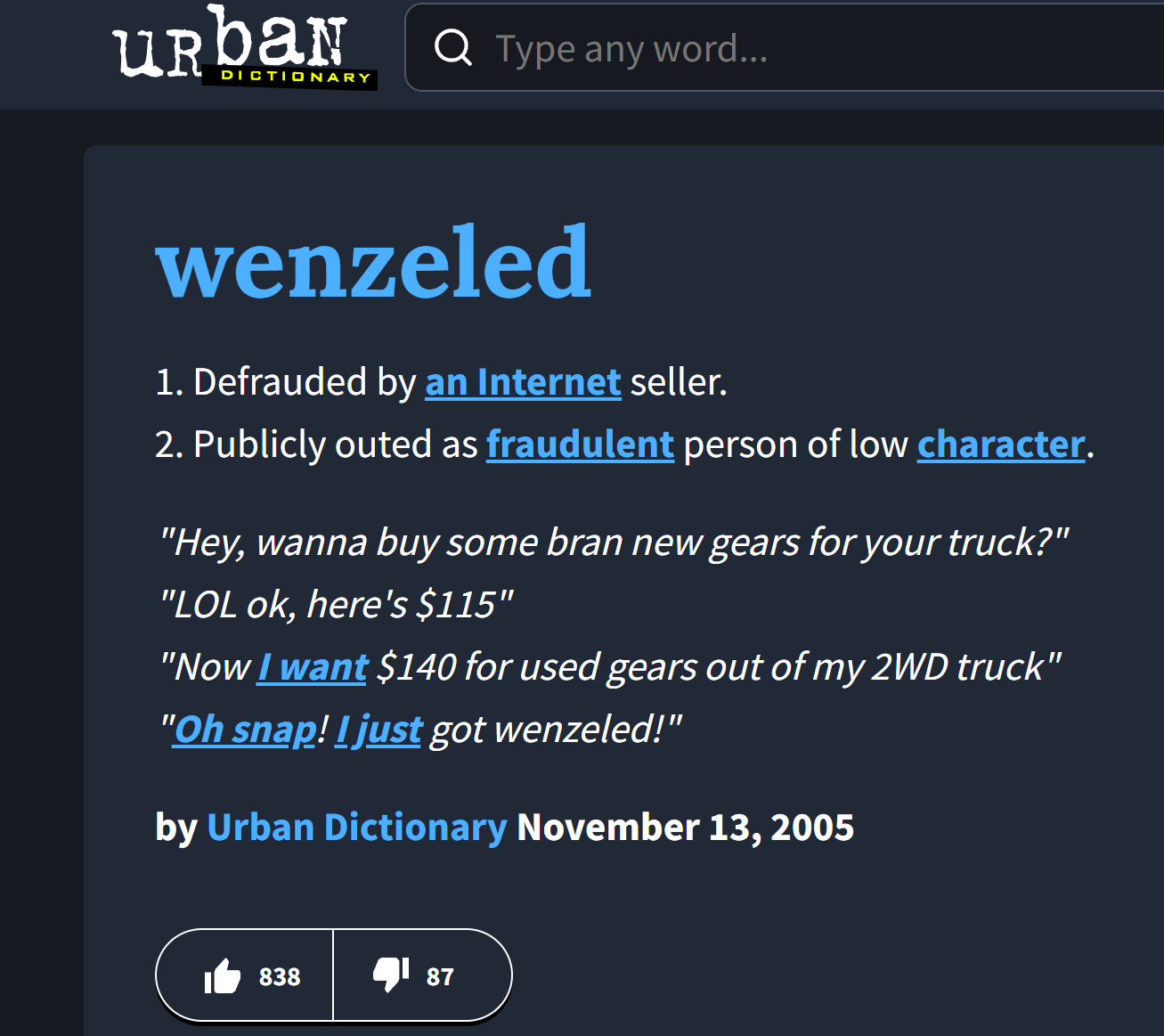
An entry in Urban Dictionary defining “Wenzeled” as “the act of exposing & bringing to justice an internet scammer”
Case studies in university ethics classes
One contemporary blogger captured the permanence of digital shame: “Unfortunately for Charlie Wenzel, many employers screen prospective employees in just that fashion. There is an illusion of anonymity in cyberspace. The reality is it can be turned against you, and burn you for life”.
Wenzel’s Self-Sabotage
Charlie Wenzel’s behaviour throughout the ordeal demonstrated a catastrophic misunderstanding of internet culture. Rather than immediately refunding MochaMike or sending the correct product, he:
Called forum members names & issued threats
Harassed MochaMike & his wife via repeated phone calls (documented through caller ID)
Claimed he was being victimised despite admitting the gears were used
Sent a 7-11 money order instead of a postal money order, which could take 30 days to clear
Posted a fake apology laden with threats, then edited it
Demanded others provide their personal information after being doxxed himself
His responses read like a masterclass in escalation. One forum member observed that Wenzel wanted to “prove a point” by showing he was “independent” rather than simply resolving the dispute, which would have cost him $115 but saved his reputation.
The Dark Side of Digital Justice
The Charlie Wenzel case sits at the uncomfortable intersection of community accountability & mob vigilantism. While the forum successfully exposed fraud & potentially warned thousands of future victims, the methods employed raise serious ethical questions.
Internet vigilantism research identifies the practice as “digitally mediated forms of vigilantism” that “scrutinise, denounce & leverage harm against those deemed to transgress legal and/or moral boundaries”. The Wenzel incident exhibits all three components:
Scrutiny: The distributed investigation compiled his personal history
Denunciation: Public shaming across dozens of platforms
Leveraging Harm: Constant phone harassment, permanent employment-killing Google results
Benjamin Loveluck’s taxonomy of internet vigilantism includes flagging, investigation, hounding & organised denunciation—the Wenzel case encompassed all four.
The practice originated in 1990s hacker culture, where “dropping docs” meant revealing an opponent’s real identity to expose them to harassment or legal consequences. By 2005, these tactics had migrated to mainstream community forums, weaponised not by elite hackers but by ordinary enthusiasts protecting their tribe.
Lessons from the Wreckage
The Charlie Wenzel saga offers several insights into early internet community dynamics:
1. Forum Architecture Matters
Persistent communities with edit tracking, long-term membership records & transparent post histories created accountability systems more effective than platform-based trust scores. The 4x4 forums’ “social proof economy” incentivised honest behaviour because reputational damage carried real costs.
2. Distributed Investigation Works—Perhaps Too Well
Crowdsourced research proved remarkably effective at uncovering fraud patterns. However, the same mechanisms that exposed Wenzel’s scam also enabled disproportionate punishment. The forum users who spent hours compiling his dossier weren’t trained investigators, had no legal oversight & faced no consequences for potential errors.
3. Digital Permanence as Deterrent & Weapon
The permanent nature of internet records transformed temporary social pressure into lifetime consequences. Wenzel’s name became synonymous with internet fraud, likely affecting his employment prospects, relationships & future opportunities. This deterrent effect may prevent future scams—but it also means a 2005 fraud by a young man follows him decades later.
4. The Line Between Justice & Harassment Blurs
MochaMike simply wanted his $115 back or the gears he’d paid for. The community delivered that—and then kept going. The harassment of Wenzel’s family, girlfriend & the constant phone calls crossed from accountability into collective punishment. Internet vigilantism literature warns of this progression, where “cyberbullying may sometimes be conducted under the guise of internet vigilantism”.
The 2005 Internet Ecosystem
Understanding why the Wenzel incident unfolded as it did requires context about early-2000s internet culture. Forums occupied a unique position in the digital landscape:
Pre-Social Media Community Building
Before Facebook (launched 2004, still college-only in 2005) & Twitter (launched 2006), forums were primary social platforms. Users spent years building relationships, sharing expertise & developing community norms. An attack on one member felt like an attack on the entire group.
Limited Platform Moderation
Forum moderation in 2005 was inconsistent. Many platforms had volunteer moderators who might tacitly approve vigilante justice if the target deserved it. The institutional guardrails that major platforms would later develop—automated flagging systems, clear content policies, legal departments—barely existed.
Information Scarcity Breeds Vigilance
Buyers & sellers had fewer tools for verification. No PayPal buyer protection. Limited credit card chargeback awareness. Scam report databases were nascent. Forums became self-policing communities because formal consumer protection mechanisms were inadequate.
The Wenzel Effect: Long-Term Impact
Charlie Wenzel became a cautionary tale referenced across internet communities for years. Forum posts from 2008, 2010 & beyond mention “being Wenzeled” as shorthand for vigilante exposure. The case established templates for how online communities would respond to internal fraud:
Immediate investigation by community members
Public documentation of evidence
Cross-platform warning campaigns
Personal information disclosure as punishment
These patterns would recur in later incidents: the “Sidekick Girl” case (2005), Gamergate doxxing campaigns (2014-15), Reddit’s Boston Marathon bombing misidentification (2013) & countless smaller forum disputes.
Some later cases involved groups like Perverted-Justice, which conducted sting operations against adults seeking minors online, collaborating with law enforcement & the To Catch a Predator television series. While Perverted-Justice positioned itself as assisting law enforcement, critics argued the tactics constituted harassment & potential entrapment—echoing debates from the Wenzel case.
Where Accountability Ends & Abuse Begins
The central tension in the Wenzel case—replicated across hundreds of subsequent incidents—is determining where legitimate community accountability tips into digital mob violence.
Legitimate aspects of the forum’s response:
Warning other potential victims about Wenzel’s behaviour
Documenting evidence of fraud for law enforcement
Collectively refusing to do business with known scammers
Public shaming as deterrent to future fraudulent behaviour
Problematic escalations:
Publishing family members’ information (they weren’t involved in the scam)
Continuous harassment via phone calls to Wenzel & his wife
Photoshopping & mocking personal photos
Creating permanent internet records that prevent rehabilitation
Research on internet vigilantism notes this pattern: “Instances of citizens targeting other citizens can also be understood from a state of vigilance that articulates an indictment against behaviours that are no longer meant to be tolerated”. The Wenzel case reflected collective frustration with internet fraud in an era when formal systems provided inadequate recourse.
But that frustration produced disproportionate punishment. Wenzel attempted to steal $25 (the price increase) & misrepresented used gears as new—criminal behaviour worth perhaps a few hundred pounds in damages. The community response inflicted reputational harm worth potentially hundreds of thousands of pounds in lifetime earning capacity.
The Forum as Panopticon
Michel Foucault’s concept of the panopticon—a prison design where inmates know they might be watched at any time, inducing self-policing behaviour—finds unexpected application in 4x4 forum dynamics. Every transaction occurred under the gaze of hundreds or thousands of observers.
This visibility creates behaviour modification through anticipated surveillance. Forum members knew their post history, transaction behaviour & even edited posts were permanently archived & could be scrutinised at any time. The knowledge that a scam attempt might trigger comprehensive investigation & permanent doxxing served as powerful deterrent.
But panopticon effects cut both ways. The same scrutiny that prevents fraud also enables abuse. Accusers face minimal accountability for false claims. Mob dynamics reward extreme responses. Proportionality disappears when thousands pile on a single target.
Legal Grey Zones
The Wenzel incident exposed significant legal ambiguities around internet vigilantism. Multiple jurisdictions were involved—California (Wenzel’s location), wherever MochaMike lived, & the locations of thousands of forum participants. Questions included:
Is publishing publicly available information (photos, addresses from phone books) legal harassment?
Do phone calls to someone’s home constitute stalking when conducted by hundreds of individuals?
Can editing a forum post after accepting payment constitute wire fraud?
What liability do forum operators have for vigilante content?
These questions remain largely unresolved two decades later. Internet vigilantism “is done outside the law, but is not always against the law”. The aggregation of public information is generally legal, though it may violate stalking & intimidation statutes. Publishing previously private information obtained through hacking is clearly illegal, but the Wenzel case involved primarily public records.
One legal analyst noted: “Vigilantes aren’t always trained or educated in investigative work & normally don’t have the credentials to be a trustworthy source for whether someone is guilty of a crime”. This creates risks of false accusations, misidentification & disproportionate responses—risks that materialised in later cases like Reddit’s Boston Marathon bombing investigation.
Modern Echoes
The Charlie Wenzel template continues influencing online behaviour. Contemporary examples include:
Local Nextdoor & Facebook groups conducting vigilante investigations into package thieves & dangerous drivers
YouTube “predator hunter” channels conducting amateur sting operations
Twitter users doxxing individuals they perceive as racist or harmful
Chinese “human flesh search engines” exposing officials & celebrities
Hong Kong protesters & police doxxing each other during 2019 demonstrations
Each case recapitulates the Wenzel pattern: perceived injustice, community investigation, public exposure, disproportionate punishment. The technology changes—forums to social media to mobile apps—but the dynamics remain consistent.
Researchers warn that “neighborhood groups can foster ‘undesirable social & moral by-products,’ as discrimination, stigmatisation, exclusion of outsiders & excessive social control”. Constant vigilance towards anything “out-of-the-ordinary” risks creating “invasive surveillance practices & a culture of mob activism, jeopardising democratic values like openness & mutual respect”.
The Paradox of Community Justice
The 4x4 forums demonstrated that tight-knit online communities could effectively police themselves, exposing fraud that formal systems might ignore. This self-governance model had genuine benefits:
Rapid response (hours vs weeks for law enforcement)
Lower burden of proof needed for warnings (vs criminal conviction)
Collective institutional knowledge about scam patterns
Direct deterrent effect on potential fraudsters
But these same communities proved incapable of proportional response. Without legal frameworks for evidence standards, punishment limits & appeals processes, collective anger escalated unchecked. The forums had evolved mechanisms for detecting fraud but not for calibrating consequences.
This paradox defines internet vigilantism: communities are often effective at identifying bad actors but terrible at determining appropriate responses. The wisdom of crowds becomes the madness of mobs.
Twenty Years Later: What We Learned
The Charlie Wenzel case offers uncomfortable lessons two decades on:
Community accountability works—with caveats. Forums successfully exposed serial fraud & warned potential victims. But the punishment exceeded the crime by orders of magnitude.
Digital permanence amplifies consequences. Wenzel’s 2005 scam follows him forever, visible to every employer, date & acquaintance who Googles his name. This severity exceeds penalties for far worse crimes.
Self-policing requires institutional restraint. Effective communities need mechanisms to prevent escalation: clear rules, active moderation, dispute resolution processes & recognition that doxxing family members crosses ethical lines.
Legal systems must evolve. The gap between consumer harm & law enforcement capacity created space for vigilantism. Better fraud reporting systems, small claims courts & platform accountability could reduce incentives for mob justice.
Technology changes, human nature doesn’t. Whether 4x4 forums in 2005 or TikTok in 2025, the impulse to punish perceived wrongdoers through collective action remains constant. Understanding this pattern helps design systems that channel accountability productively rather than destructively.
When you get caught red handed - fess the fuck up
Charlie Wenzel tried to steal $25 & sold used gears as new. He should have faced legal consequences, reputation damage & difficulty conducting future transactions in those communities. Instead, he became internet folklore, his name permanently synonymous with scamming, his personal information broadcast to hundreds of thousands, his family harassed, his future employment prospects destroyed.
The 4x4 forums detected the fraud. Then they detonated a nuclear bomb on a pickpocket.
Sources
The Charlie Wenzel incident demonstrates both the power & peril of community-driven accountability in online spaces. Forums successfully identified fraud through collective vigilance, transparent record-keeping & distributed investigation. But the same mechanisms that exposed wrongdoing enabled disproportionate punishment, permanent reputational destruction & harassment of uninvolved parties. Two decades later, these tensions remain unresolved as new platforms replicate old patterns, proving that internet vigilantism evolves in technology but not in ethics. The case serves as permanent cautionary tale—not just for would-be scammers, but for communities wielding the dangerous power of collective exposure.
I go much Further & Deeper, in the rest of the article… (usually…)
You are currently about 100% through this article.
Paid subscribers get access first.
[Depending on the article size/content]
Timed or Fully Paywalled content may apply - Free trial offer if you’re tempted. 😎
Support keeps the articles flowing & for when Westminster or GBNews gets litigious. 😏
~ 200 Articles free in my vault if you want to sample my work & decide after. 😉
If it made you think or laugh, like or share- Support the Writer with a Coffee?
Housekeeping™©2025
Charlie, if you are reading this, you were one stupid motherfucker, but thanks for the laughter man, seriously.
- End of Political Satirical Dispatch - ™©2025
Stay Frosty People. 😉
This Article was Powered by Coffee & Subscriptions.
Truth To Power - Power To Truth.™©2025
The Game Has Changed™©2025
Fact Check Or Get Out.™©2025
P.S LegalShield™©2025
No fucks given, it’s history.
P.S Right to Reply™©2025
P.S Receipts™©2025
Google search or AI, and the trail is still there.
P.S Social Media Bio:
End of Line…
