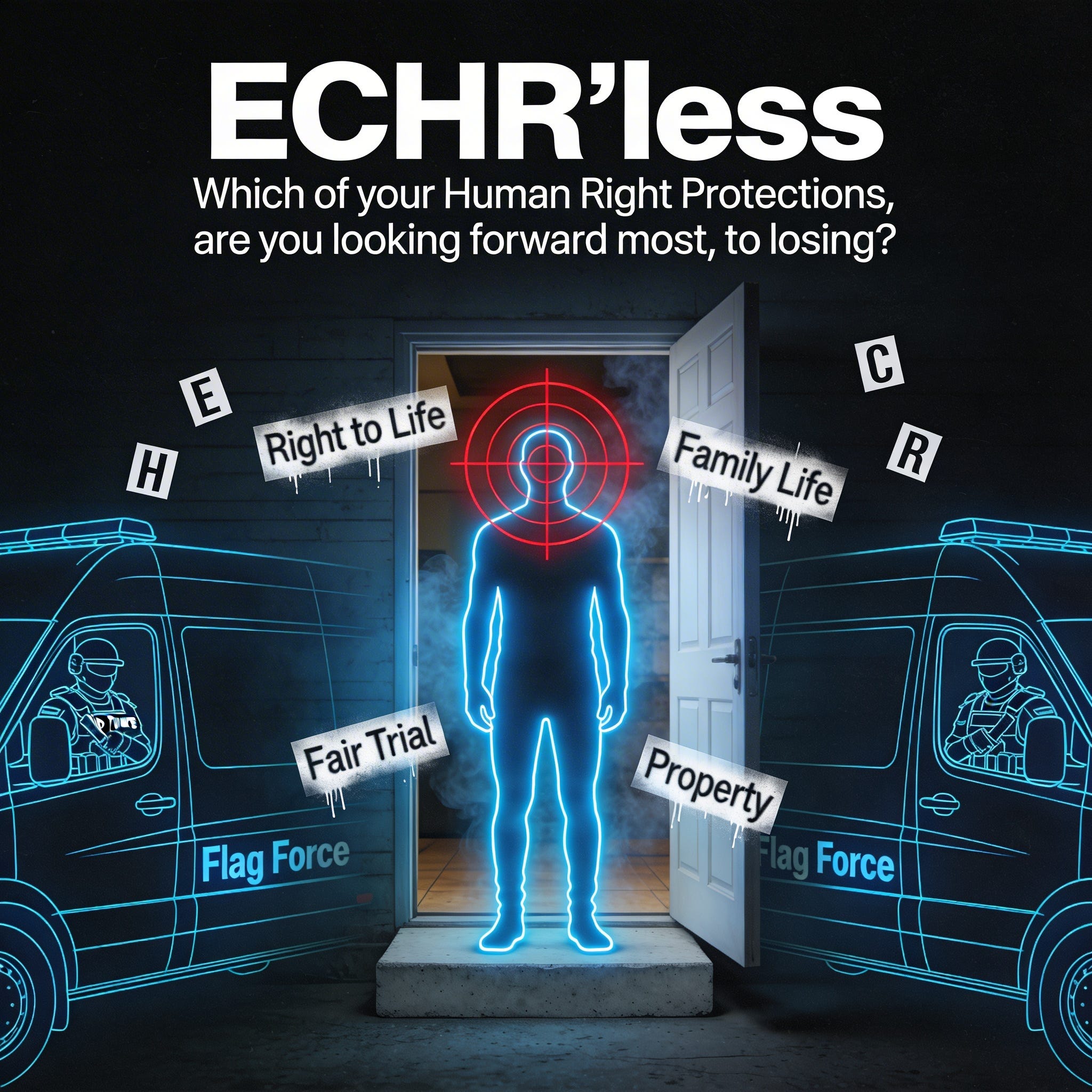
ECHR’less ™©2026
Which of your Human Right Protections, are you looking forward most, to losing?
Prelude: Before The Storm.
They promised you it would never be you.
That was the sales pitch. That was the comfort blanket. That was the lullaby Reform hummed into every microphone.
It will only be them.
The promise
They told you:
It’ll only be the “illegal immigrants.”
It’ll only be the ones who “don’t belong here.”
It’ll only be the people who “haven’t paid in.”
It’ll only be the “foreign criminals” gaming the system.
It’ll only be the “health tourists” blocking your mum’s cancer treatment.
It’ll only be the protestors “stopping you getting to work.”
They said “European Court of Human Rights” & made it sound like a free legal hotline for paedophiles, terrorists & Albanian gangsters.
They said “we’re just taking back control from foreign judges.”
They said “if you’ve done nothing wrong, you’ve nothing to fear.”
You believed them because you wanted to.
Because they pointed at someone poorer, browner, more desperate than you & said: that’s the queue‑jumper, that’s why your life is shit.
The stupid weren’t the only problem.
The tired were.
The list of people you were told not to care about
They trained you, slowly, to look away.
First it was the boats.
Faces you only ever saw as long‑lens dots on the sea. You’d never meet them. So who cares what happens in some detention centre you’ll never visit.
Then it was the “foreign criminals.”
Grainy CCTV of a knife, a mugshot, a surname that wasn’t Smith.
“Why are we letting a human rights court stop us putting this scum on a plane?”
Then it was the “scroungers.”
The disabled man whose assessment got “tightened.”
The woman sanctioned because she missed an appointment while she was in A&E.
“Why should they have rights when you’re working full‑time & still broke?”
Then it was the “extremists.”
The kid with a placard.
The nurse on a picket.
The granny in a wheelchair who showed up to a protest.
The teacher who refused to shut up about underfunding.
“Why should they get to block roads & scream in your face?”
Every time they said “we’re only going after them,” the category quietly widened.
Every time you nodded along, the circle shrank a little closer to your own feet.
The thing that was in the way
What they never spelled out on telly was what the ECHR was actually for.
They didn’t say:
“We’re angry because a torture ban means we can’t deport people into secret prisons & pretend we didn’t know.”
“We’re furious because the right to family life sometimes stops us ripping kids from parents to hit a deportation target.”
“We hate this system because it says we can’t just shoot people in the street, call it ‘regrettable’, & move on.”
They said:
“The ECHR is stopping us protecting you.”
“Human rights are being weaponised against the British people.”
“We need a British Bill of Rights for British citizens.”
They never added the line in brackets:
(…until you stop being useful.)
Because once you’ve swallowed the idea that some people don’t get rights, you’ve already accepted that rights aren’t rights at all.
They’re a membership perk.
Subject to terms & conditions.
Cancelled at the state’s convenience.
How they softened you up
By the time they finally stood up & said “we are leaving the ECHR,” they’d spent years working on you. A decade or more of the Conservatives on their last outing as a government, tried to sell it and push it into existence long before the rebranded Tories who fled to the Hotel Turquoise as Kemi Badenoch destroyed what the electorate had spared after the last fair General Election in the UK of 2024, and then Reform bought and conned their way into power.
You’d been told the court only ever helped terrorists & rapists.
You’d been told “human rights” were why your neighbour couldn’t get a GP appointment.
You’d been told anyone defending the Convention was a “traitor”, a “globalist”, an “enemy within.”
So when the vote came, you could tell yourself:
It’s fine.
It’s tidy‑up.
It’s only them.
This story is what happens on the day you find out who “them” actually is.
Spoiler: it’s your neighbour, your mate, your auntie, your kid.
Spoiler: it’s you.
Parliament didn’t explode.
It just went quiet.
The night of the vote
One late Thursday, on a three‑line whip & a dead‑eyed majority, they pushed it through.
The Sovereign Rights Act.
Repeal of the Human Rights Act.
Withdrawal from the European Convention on Human Rights in two sides of legal boilerplate.
Most of the MPs voting for it hadn’t read the details. They didn’t need to. They knew the lines. Most of the MPs were bought and paid for…
“Take back control.”
“Foreign judges.”
“Criminals walking free.”
At 00:01, the switch flipped.
No sirens. No tanks.
Just emails.
Police got “updated public order guidance” & a new annex on “Sovereign Security Incidents.”
The Home Office got “revised detention powers” & a note that Strasbourg references were now “obsolete.”
Courts got the memo: no more human rights arguments from that old treaty, no more appeals to any court outside the island.
NHS managers got “clarification” that life‑and‑death decisions were now “a matter for domestic law alone.”
Councils got “new duties” on protest control, migrant “dispersal,” community surveillance.
It looked like admin.
That was deliberate.
No alternate version of the ECHR or the HRA was proposed let alone brought in, it wasn’t even discussed…
Week one: the proper channels
The first week after the switch, people behaved.
Lawyers did what lawyers do.
They filed urgent judicial reviews, waved dusty copies of the Convention in front of bored judges, argued that Parliament couldn’t just scrap half a century of rights architecture with a late‑night vote.
Campaigners did what campaigners do.
Emails to MPs.
Petitions.
Media briefings on Article 3, Article 8, Article 10, all the invisible plumbing that had quietly held the ceiling up since the 1950s.
Churches held vigils.
Unions put out strongly‑worded statements in the careful, neutered tone of people who still thought shame could move a government.
Protests were organised by the book.
Notices in on time.
Agreed march routes.
Volunteer stewards in hi‑viz.
Leaflets explaining what “no torture” actually covers, why “right to a fair trial” isn’t some foreign luxury.
On the other side of the camera, ministers smiled.
They said nothing had really changed.
They said British rights would be “stronger now, because they’re ours.”
They said only “illegals, foreign criminals & left‑wing extremists” needed to worry.
The papers did the soft sell.
“FUSS OVER LEGAL TIDY‑UP.”
“LEFTY LAWYERS FUME AS REFORM RESTORES SOVEREIGNTY.”
Most people scanned the headlines on the bus & scrolled back to football.
Week two: the test
The first weekend after that, the marches got bigger.
More banners.
Less patience.
The chants stopped asking politely & started calling things by their names.
On Sunday shows, the line hardened.
“Peaceful protest is a proud British tradition,” they said.
“But we cannot allow extremist agitators, foreign‑funded NGOs & migrant‑shielding lawyers to hold our streets to ransom.”
On Monday morning, new regulations landed in inboxes: the Public Order (Sovereign Security) Regulations.
Protests could be banned in advance if they posed a “risk to national cohesion” or “economic stability.”
“Serious disruption” now meant anything that slowed traffic, dented profits or embarrassed a minister on telly.
Spontaneous gatherings of more than ten people were “unauthorised assemblies” subject to dispersal “by appropriate means.”
On Wednesday, in Manchester, London, Glasgow, Bristol, people marched anyway.
This time the kit came out of the older cupboards.
Shield lines.
Helmets.
Archaic Federal Riot Guns from the back of the armoury, the ones Gen X remembers from the news.
37 mm launchers with L2A2‑style baton rounds: six inches long, inch‑and‑a‑half across, 145 grams of hardened rubber designed in another era to put people on the ground fast.
On paper, “less‑lethal munitions.”
In reality, the same rounds that blinded, maimed & killed in Northern Ireland & on British streets for decades.
Most of the rank‑and‑file weren’t keen.
They’d joined to nick burglars, not fire museum‑piece riot guns into crowds of nurses, teachers & pensioners yelling “NO TORTURE IN OUR NAME.”
You could see it in the way some of them held the batons.
You could hear it in the way they muttered “sorry” as they pushed people back.
The Home Secretary noticed.
By Friday, the front pages had their angle.
“SOFT‑TOUCH COPS LET MOB RUN RIOT.”
“POLICE KNEEL TO WOKES AS REFORM VOTERS WATCH.”
On Saturday, outside a line of flags, the Prime Minister did the line history will pretend was subtle:
“Our brave officers must be empowered to act.
If they cannot or will not enforce the law, we will find those who can.”
Message received…
The purge
The following week, it looked bureaucratic.
No one called it a purge.
They called it “raising professional standards.”
Internal investigations opened on officers who’d refused orders or taken off helmets on the line.
‘Disciplinaries’ were held, too many to do individually, so they held group hearings instead. Those that wouldn’t follow the new guidelines or had been caught being “soft on crime.” Gone inside 12 minutes.
Early retirement “offers” for anyone with twenty years’ service & a conscience.
Desk jobs in forgotten units for inspectors who questioned the legality of the new powers.
Hardline Officers ‘took care of their own’ and dished out private beatings to those they thought were “soft”. Individuals cornered by packs, and savaged without mercy.
One chief constable said on local radio that “we police by consent, not fear.”
He resigned for “family reasons” three days later.
By the end of week two, the shape of the force had changed.
You were left with:
The ones too close to pension to kick back that were now restricted to paper shuffling.
The ones who told themselves it was “just until things calm down.”
The ones who were openly enjoying it.
That third group was still a minority.
But they were the ones Reform wanted in front of cameras.
They still weren’t enough.
Not for what came next…
The recruitment drive
On right‑wing channels they’d spent years sneering about “woke police.”
Now they did something useful.
They opened Facebook.
They went trawling:
The blokes who’d spent a decade posting “HANG ’EM” under every crime story.
The self‑styled “patriots” who’d live streamed themselves “patrolling” hotels & beaches for migrants.
The accounts with wall‑to‑wall flags & racial slurs in the comments.
The lads who’d gone to France to slash dinghies, pose with banners, play soldier with other middle‑aged bigots.
The “patriots” that set up roadblocks challenging women drivers & intimidating people in a Stella fuelled rage.
All publicly available.
All already tagged by the platforms’ own ad systems as “highly engaged.”
Then they hacked their way into the Private Groups, where all the racists had been hiding out, away from most of the public eye, the real hardcore they were looking for.
The ad was simple:
FLAG FORCE – PROTECT YOUR NATION
Competitive salary.
Tasty sign‑on bonus.
Uniform provided.
No experience needed.
Tired of watching your country be destroyed by criminals, migrants & traitors?
Join the frontline.
There was a photo: a bloke in tactical gear, smug half‑smile, Union Jack patch, FLAG FORCE in a font trying hard to look serious.
The sign‑on bonus made the tabloids.
“£100,000 FOR NEW FLAG FORCE OFFICERS – REWARDING REAL PATRIOTS.”
But the truth was uglier.
Most of the lads who signed weren’t doing it for the money.
They were doing it for permission.
Permission to do, in daylight, with a badge, what they’d been fantasising about in comment threads for ten years.
Permission to hit, to humiliate, to stalk streets in packs & know the state would back them.
The kit arrived in crates.
Fresh uniforms.
Old baton rounds from deep storage.
Manuals rebranded “Sovereign Security Doctrine” that quietly binned what little restraint had been learned the hard way in Belfast.
Training was short.
Half a day of legal training that was merely theatre.
One day of PowerPoints on “proportionate force.”
An afternoon on the range firing L2‑style rounds at plywood silhouettes & laughing when they punched straight through.
The rest was training on how to form a baseline and use a 6 foot riot shield as a deadly weapon, how to use CS Gas grenades, and where to hit someone with a baton to snap bones. Snatch squad techniques and arrest & restraint methods, outlawed in most civilised countries long ago. Taught by instructors who were gearing people up to maim, inflict maximum damage and dish out pain or injuries that were beyond effective, they were a statement of intent…
The real curriculum fit on a single slide:
You are the line.
We have your back.
Do what needs to be done.Make sure “they” know, resistance isn’t futile, it’s deadly.
By the time Monday comes in this story, they’re not rumours any more.
You’ve already seen the videos.
You’ve already heard the shots at a distance.
You’ve already watched one walk past your bus stop & felt yourself instinctively look at your shoes.
They’re not the future.
They’re the present.
On Monday, they’ll learn your name.
&, where you live.
Where your family live.
Who your friends are.
Who you talk with online.
What you say or have said.
Social media became their ultimate weapon initially.
& they used it with maximum, devastating effect.
Mass deletion of social media accounts occurred when people started to sense what was happening. It didn’t matter, they already had your details, they had gained access already and were ready. The people that had made sure the election went the right way, owned your data already. They’d had it for a long time, and had made Billions from it already. Now they used it to control elections or voting, and they just got their way…
A few months later, the UK had changed dramatically, it wasn’t subtle once it started, the changes were broad, sweeping and the media were busy spinning the many stories this kind of government needed at first, massive deportations, people they wanted punished, were punished, and any media that wasn’t friendly? Vanished overnight.
No one asked questions, not once they saw what happened if you did.
Monday: Welcome to hell
The alarm goes at 03:00.
You don’t bother hitting snooze. You can’t afford to.
If you miss the four o’clock bus, you miss the five o’clock clock‑in. Miss the clock‑in, your “Participation Score” drops another notch. Too many notches & your food credits go. Too many notches after that & you get an invitation to “voluntary relocation.”
So you get up.
You piss in the dark.
You dress in yesterday’s sweat.
You leave the flat without turning the light on because the meter is already in Emergency Credit.
Electric prices had exploded, they shut the Solar farms down, then smashed them up.
The wind farms and other renewable sources, same fate.
Fossil Fuel was king, the companies who had paid the politicians for decades, had the power now.
Supply & demand, didn’t meet in the middle, so restrictions and Brownouts, became a regular thing. That became handy for those in power, darkness was their friend, it certainly wasn’t yours…
What goes on in the dark, causes far more fear, to those dreading being caught out in it. The bogeyman was now real, and he carried a big stick and knew how to use it.
Morning: the walk
The streets are quieter now, but not in a peaceful way.
The old 24‑hour shops have gone to card‑only vending. The night buses have been cut to the bone “to save the taxpayer.” Every bus that was in service, was rammed full of people, veal crate like.
The people who used to sit on the steps smoking and talking till 2am don’t risk it anymore. Not since the first curfew sweeps.
You walk the same route as always. Same cracked paving slab. Same corner where the smell of piss never quite leaves.
There are two vans at the end of your road.
White. Boxy. No markings on the sides.
You know what they are anyway.
One normal police car, blue lights on but lazy. Two uniforms standing by it, hands in stab vests, coffee steam in the glow. And behind them, at an angle, the white vans.
The back doors are shut. The engines idle. You can see breath from the exhausts in the cold air.
A strip of yellow tape across the entrance to the cul‑de‑sac.
A body on the floor under a thin grey sheet.
You can see the boots.
You recognise the laces.
You don’t look long enough to be seen to be caring. You look at the ground instead, at the little plastic sign they’ve put up on a metal spike.
UNAUTHORISED PRESENCE AFTER CURFEW
LETHAL FORCE LAWFULLY DEPLOYED
COMMUNITY SECURED
You step around it like it’s a roadwork.
One of the uniforms looks at you like he wants to say something & thinks better of it. Behind him, leaning on the bonnet of one of the unmarked vans, is a man in a black hoodie with a tactical vest over the top.
FLAG FORCE across the chest.
Union flag velcro patch on the shoulder.
Disposable coffee cup in his hand.
He takes you in, head to toe.
Checks your hi‑viz.
Checks the pass on your lanyard.
Checks your face for any flicker of disgust.
You give him nothing.
You look down.
You walk on.
You’re late if you don’t.
The bus
The bus is rammed, you barely manage to fit on and the door struggles to close.
Faces you know but don’t.
Work faces.
Queue faces.
People you’ve shared air with for years without ever sharing a word.
The screens are on at the front, volume low.
News channel.
They want you to watch any chance you have a moment that isn’t controlled by them.
They’re replaying last night’s footage from the city centre. The march that wasn’t supposed to happen. The kettle. The flash of old‑style baton rounds in the streetlights. The last moments of a public standing up for what it knew, and they were made to pay the ultimate price for even daring.
A presenter smiles the way presenters do when they’re talking about something they’ve never experienced.
“Somehow,” she says, “these protesters still don’t understand that the public has spoken. The government has restored control. The days of foreign courts telling us how to run our country are over. And if extremists don’t like it, well… they can stay at home.”
Underneath, the ticker scrolls:
COMMUNITY PROTECTED AFTER CLAMPDOWN ON ILLEGAL ASSEMBLY
FLAG FORCE PRAISED FOR “FIRM BUT FAIR” RESPONSE
Nobody on the bus comments.
Crammed so tight you can barely draw breath.
One bloke close by gives a tiny snort through his nose.
The driver glances at the mirror, then back to the road.
You wonder if the driver is going to report it…
You never know these days.
You watch the replay of a woman on the ground, hand to her face, blood leaking between her fingers. You can’t see what hit her. You don’t need to. You’ve seen one of those rounds up close.
145 grams of hardened rubber fired from a Federal riot gun at 60 metres a second…
They called it “less lethal” on the graphics. The same as it was marketed as back in the days when they were first issued to the Army, it was a lie then, it’s a bigger lie now.
Her eye doesn’t know the difference.
You look away.
You tell yourself you’re just tired.
The factory
The factory used to be called something. A company name. A logo. A brand.
Now it’s the National Productivity Hub – Zone 4.
The old sign is still there under the new one, faint through the grey paint. The last letter of the old logo peeks out like a bruise.
You badge in at the gate. The turnstile clicks.
The security guard used to be the kind of bloke who’d chat football. He’s quieter now. There’s a camera strapped to his chest and a little Flag Force sticker on the window of his booth that wasn’t there last month.
“Morning,” you say, because habit is harder to kill than hope.
He nods.
His eyes flick to the monitor behind you.
Inside, the floor smells of oil, metal, bleach, sweat.
& as ever now, the coppery smell of blood…
The machines are older than you. The guards on the belts are cracked. The emergency stop cords hang at odd angles where they’ve been pulled so many times the fixings have given up.
You remember, vaguely, a safety rep once. Posters about PPE. Toolbox talks. The occasional shut‑down after an accident.
That was before the ECHR went.
Before Reform told you that “red tape” was why your wages were shit.
Now the PPE cupboard is empty most days.
Gloves, if you get there early.
Ear‑defenders with one side broken.
Masks if you’re “high risk” according to last year’s memo.
There’s a new poster by the clock‑in machine.
NATIONAL PRODUCTIVITY IS NATIONAL SECURITY
REFUSAL TO WORK = ECONOMIC SABOTAGE
SABOTAGE IS TREASON
You touch your card to the reader.
The screen flashes green.
Your mate from line three is standing at the next station along, rolling his shoulders like he’s trying to shift a permanent knot.
“Alright,” he mutters.
You grunt back.
You both saw the body under the sheet, but you’re not going to be the first to mention it.
The Patriot Portal
You’re fifteen minutes into the shift when the tannoy crackles.
“Attention all staff,” the voice says, flat. “Please log in to the Patriot Portal on your terminals during your first break today & complete the National Alignment Questionnaire. Completion is mandatory for continued system access.”
The line supervisor pretends not to hear.
The lads pretend not to notice.
At break, the Portal is already up on your desktop when you sit down.
The logo is a stylised flag.
The tagline: ONE PEOPLE, ONE LAW, ONE FUTURE.
You click “Start”.
Question one: “Do you support the Reform Government’s Sovereign Security Programme?”
Question two: “Do you agree that foreign courts should not interfere with British decisions?”
Question three: “Do you agree that some people abuse human rights to escape justice?”
Each one has the same three options:
STRONGLY AGREE.
AGREE.
AGREE BUT WITH RESERVATIONS.
There is no disagree.
At the bottom, a bar:
Completion of this questionnaire is a condition of ongoing employment under the National Productivity Scheme.
Across the table, the lad from line three is staring at his screen.
“This is bollocks,” he says, quietly. “It’s just bloody loyalty oaths now.”
Someone further down hisses, “Shut up.”
He looks at you.
“What are you putting?” he asks.
You shrug.
You click AGREE BUT WITH RESERVATIONS because you’ve still got rent to pay & a body on your street this morning.
He stares a second longer, jaw working, then pushes his chair back.
“Fuck this,” he says. “I’m not ticking some fascist survey so they can say I wanted this.”
He goes to close the window.
The terminal freezes.
A red box pops up: NON‑COMPLIANCE DETECTED. PLEASE AWAIT SUPERVISOR.
You feel your stomach drop.
Two minutes later, before anyone finished their tea, the supervisor appears at the door with someone you don’t recognise.
Black hoodie. Tactical vest.
FLAG FORCE on the chest.
“Just a quick chat, mate,” the supervisor says, voice cheery & brittle. “Bit of a glitch in the system. They’ll get you sorted.”
The Flag Force man smiles like a dentist. The full set of “Turkey teeth” flashing menace and making it clear, there is nothing but pain ahead…
“Won’t take a minute,” he says. “We just want to make sure you understand the questions.”
The lad from line three goes with them because what else is he going to do.
He doesn’t come back before the end of the shift.
Lunch: the bodies again
You eat in the canteen because there’s nowhere else warm.
The screens are on again.
Now the footage is from your town.
A still from a drone: a knot of people at the bottom of your road, yellow tape, a grey sheet, those boots.
The commentary is soft.
“Tragic, of course,” the presenter says. “No one wants to see this. But we have to remember: curfew rules are there to protect decent, hard‑working citizens. Flag Force officers have to make split‑second decisions to keep communities safe.”
Underneath:
CURFEW BREACHER NEUTRALISED NEAR PRIMARY SCHOOL
RESIDENTS PRAISE FIRM RESPONSE
“We regret of course that four children were also injured during the detention.”
Nobody in the canteen speaks.
You realise you’re holding your fork too tight. Your knuckles ache.
On the far wall, someone has scratched something into the paint with a key.
NO TRIAL
NO RIGHTS
NO CHANCE
Someone else has tried to scrub it off.
The words are faint now.
You can still read them if you know what they say.
Home: the knock
You make it through the rest of the shift without losing a finger, which passes for a win now.
On the way out, the security guard won’t meet your eye.
The Patriot Portal screen is still up on some desks, frozen on that red NON‑COMPLIANCE message.
You don’t see the lad from line three.
His coat and bag, are where he left them when he badged in that morning.
You know they will be there still in the morning…
You badge out.
You walk back the way you came, past the cul‑de‑sac where the body was.
The tape is gone.
The sheet is gone.
There’s a dark patch on the pavement that the council jet‑wash hasn’t got to yet.
They leave them for days, to send the message.
On the lamppost at the corner, someone has stuck a small sticker.
FUCK REFORM.
It’s barely bigger than your thumb.
White letters on black.
Crooked.
Someone has circled it in red spray paint.
There’s a number under it: CAMERA 4 – 03:42.
You feel the hairs on your neck go up. You look around without meaning to.
There’s a van parked just out of sight behind the row of bins.
White. Idling.
You don’t see anyone inside, but you can feel the eyes.
You don’t touch the sticker.
You don’t even slow down.
You go home.
You sit on your bed in your coat because the room is cold.
Through the window you can just see the corner where the body was.
You tell yourself tomorrow will be better.
You tell yourself they’re only going after the ones who break the rules.
You tell yourself you’re tired, not scared.
You nearly believe it.
Then, somewhere out in the estate, a van door slams & somebody starts to scream.
Tuesday: Same shit different day, yet worse
The alarm goes at 03:00 again.
You don’t remember sleeping. You remember closing your eyes & opening them & nothing in between.
Same piss in the dark.
Same clothes on the chair.
Same walk down the stairwell that smells of damp & cheap bleach.
You open the main door of the block & stop.
The vans are back.
Morning: the visit
They’re not at the end of the road this time. They’re right outside your building.
Two white boxes, engines running, exhaust hanging low in the cold air. One marked police car in front, lights off, windows fogged.
On the grass strip by the path, there’s a cluster of people in dressing gowns & coats over pyjamas. Your neighbours.
They’re all facing the same way.
Like they’re watching telly that’s happening in real life.
You follow their eyes.
Flat 3B. Two doors down from yours.
Door open.
Light on.
Inside, you can see the edge of the hallway & a pile of shoes.
Outside, on the concrete, a woman on her knees. Dressing gown, open, naked body on display, bare feet, hair wild. Hands held out, not quite daring to touch the two men in black hoodies & tactical vests in front of her. Too scared to cover herself up.
FLAG FORCE across both chests.
Between them, held by each arm, her son.
They both stare at the breasts and thick pubic hair triangle on display, leering, knowing she won’t dare cover herself…
You’ve heard him shouting at night. You’ve heard music through the wall. You’ve heard three different versions of “he’s trouble” over the last year.
Right now he’s not shouting. He’s just trying to twist away without quite pulling free, like a dog that knows the lead is on.
“Please,” the woman says. “Please, he’s just a kid. He’s not political. He doesn’t even vote, he’s just—”
“Listen carefully,” one of the Flag Force men says, in the tone you use on a call centre script, “your son has been identified in connection with anti‑state messaging & incitement.”
“He shared a video,” she says. “Everyone shares bloody videos.”
“Listen carefully” the man repeats, “he’s been invited for questioning at a Sovereign Security Facility. If he cooperates, this will go easier. For everyone.”
Behind you, someone mutters “don’t get involved” under their breath.
The lad twists again. You see his face for half a second.
It’s the kid who fixed the lift last winter when the council didn’t come. The one who carried your shopping up the stairs when your knee went.
He catches your eye.
It’s a flick, almost nothing, but you see the question:
You going to say anything?
You do what everyone else does.
You look down.
You step past.
You walk to the bus stop.
Behind you, the van door slams.
The commute
The bus is rammed, but you arrived in time, that is all that matters.
The same faces, no one talks, everyone looks shattered, despair replaced makeup, fear replaced smiles.
The news screens are now split‑screen: footage from the marches on one side, studio panel on the other.
Three guests.
One in a suit saying “reasonable concerns about judicial activism.”
One columnist saying “ordinary people are sick of criminals hiding behind human rights.”
One “security expert” explaining how “AI data fusion” now lets the state track “online extremism” & “subversion in homes” in real time.
Underneath:
NEW POWERS HELP IDENTIFY “ENEMIES WITHIN”
REFORM PROMISES “NO HIDING PLACE” FOR RIGHTS ABUSERS
The word abusers hangs there.
It’s doing a lot of work.
A woman two seats down from you clutches her bag tighter when the panel cuts to a shot of a group of young lads on a march.
You recognise one of the lads from the estate.
You keep your face still.
The presenter says: “Of course, if you’ve done nothing wrong, you’ve nothing to fear.”
Someone at the back of the bus laughs once, sharp, then coughs to hide it.
The driver turns around and you can tell, he’s clocked who did it.
You now know, they won’t be on the bus tomorrow…
Work: the empty station
The factory smells worse today.
Or you notice it more.
At the gate, the security guard still has the little Flag Force sticker in his window. There’s a new sign taped next to it.
ALL STAFF REMINDED:
SUPPORT FOR ILLEGAL ASSEMBLY, ONLINE OR OFFLINE,
IS A BREACH OF THE NATIONAL PRODUCTIVITY CODE.
You badge in.
The coat and bag, have not moved, you were right.
Inside, on line three, there’s a gap.
The station where the lad from yesterday should be is empty. The tools are lined up. The machine is running. There’s a piece of paper on the desk.
TEMPORARILY REALLOCATED – DO NOT ADJUST SETTINGS
You feel something cold settle under your ribs.
The supervisor comes down the line, eyes flicking between clip‑board & faces like he’s counting livestock.
“Right,” he says, forced cheerful, “we’re a man down on line three for now. We’ll be redistributing tasks. Everyone just needs to pull together, yeah? National effort.”
No one asks where he is.
No one says his name.
Later, in the bogs, someone has written it on the back of a cubicle door anyway.
First name.
Question mark.
Underneath, in a different pen:
“FLAGGED.”
The noticeboard
At break, you go to the canteen.
There’s a new board by the door. It used to be staff birthdays. Now the coloured paper has gone. It’s all white.
COMMUNITY COMPLIANCE UPDATES.
Three printed notices pinned in neat rows.
NOTICE 17 – “Individual detained under Sovereign Security Powers following online incitement. Investigation ongoing.”
NOTICE 18 – “Curfew enforcement operation successfully neutralises threat near primary school. No impact on attendance.”
NOTICE 19 – “Unauthorised footage of recent public order operations constitutes dissemination of extremist material. Sharing such content may constitute a criminal offence.”
Each one has the same line at the bottom:
REMEMBER: RIGHTS ARE FOR LAW‑ABIDING CITIZENS.
You read that twice.
You think about your neighbour’s kid.
You think about the sticker on the lamppost.
You think about the body under the sheet.
You wonder when exactly they decided he’d stopped being law‑abiding.
Lunch: church
At lunch you go out.
Not far.
Just two streets over, to the squat little church by the mini‑roundabout. Now no longer daubed in B&Q’s finest cheap as chips Red & White “flagged”, it’s Turquoise and has that specific white arrow symbol, they all do…
You’ve never been religious. You don’t go for God. You go for the food bank.
Or you used to.
Today the gate is chained.
The poster that used to list opening hours & warm‑bank days has been covered with a laminated notice.
BY ORDER OF THE SOVEREIGN WELFARE OFFICE
UNSANCTIONED FOOD DISTRIBUTION IS SUSPENDED
DUE TO RISK OF ECONOMIC DESTABILISATION
AUTHORISED SUPPORT IS AVAILABLE VIA OFFICIAL CHANNELS ONLYALL RELIGIOUS BUILDINGS ARE NOW CLOSED BY ORDER OF REFORM
NATIONAL RELIGION CENTRES WILL BE ANNOUNCED SHORTLY
There’s a hand‑written sign taped below it in blue marker.
SORRY.
WE TRIED.
You stand at the gate a moment longer than is safe.
Inside the yard you can see the stack of empty crates. A battered trolley. The door to the church hall shut.
A man in a suit you don’t recognise appears on the path.
Not a priest. No collar.
Clipboard in hand, lanyard round his neck with a barcode & the Reform logo.
“Can I help you?” he asks.
You tell him you were just looking for the food bank.
You already worked out what National Religion Centres means.
He smiles with his mouth, not his eyes.
“Good news,” he says. “We’ve replaced that system with something much more efficient. You can apply for Sovereign Support Credits online. That way we can make sure help goes to people who deserve it.”
You ask what that means.
He tilts his head.
“Well,” he says, “to law‑abiding citizens. People aligned with our national values. We can’t have extremist networks using charity as cover, can we?”
You don’t argue.
You know what unaligned looks like now.
You walked past it this morning.
Afternoon: the call
Back on the line, the machines roar. The supervisor prowls. The air tastes of metal & tired.
Halfway through the shift, your terminal pings.
A message flashes up over whatever you were pretending to work on.
COMMUNITY SECURITY ALERT
YOUR AREA HAS BEEN IDENTIFIED AS A SITE OF HEIGHTENED RISK
CURFEW WILL NOW BEGIN AT 19:00
NON‑ESSENTIAL MOVEMENT AFTER THIS TIME IS PROHIBITED
Underneath, in small print:
Flag Force has been authorised to assist with enforcement operations.
You look at the clock.
You do the maths.
Bus. Walk.
If the line overruns, you don’t make it.
You go to the supervisor.
“Curfew has moved,” you say. “I need to get back before seven. My block’s on the list.”
He looks at you, then at the nearest camera.
“Curfew is nothing to do with me,” he says. Louder than he needs to. “We’ve got targets. We’re all making sacrifices.”
You stand there a second, waiting to see if he’ll blink.
He doesn’t.
“You can always apply for exemption,” he adds. “There’s a form in the Portal. They’ll get back to you.”
You’ve seen how quick the Portal is when it’s about taking something away.
You nod.
You go back to your station.
You work faster.
Evening: the sweep
The line overruns.
Of course it does.
A belt jams.
A sensor throws a wobbly.
Someone nicks a finger & there’s blood on the housing.
By the time you’re out of the gate, the sky’s already turned that flat blue‑grey that means streetlights are about to come on.
You don’t wait for the bus. You walk. At a higher pace, tempus fugit…
You cut down side streets, past shuttered shops & the odd lit window. You keep checking your watch. You feel stupid for doing it. Curfew is always something that happens to other people. People on news screens. People in the bad parts of town.
You turn into your estate & hear it before you see it:
The echo‑thunk of something heavy hitting tarmac.
The delayed scream.
The shout of orders that are more for show than communication.
You slow for half a second, then force yourself forward.
At the corner, you see the line.
Flag Force. Six of them this time. Black hoodies, tactical vests, helmets. Federal riot guns held low.
Across from them, a handful of kids.
Not masked, not armed.
Hoods up, hands open, backs against a wall.
You recognise one.
Two doors down from your block.
Always on a scooter.
Always too loud.
He’s shouting now.
“We’re just going home,” he yells. “It’s my street, man. I live here. Look—”
He half‑steps forward, pointing at his own front door.
One of the Flag Force men raises his riot gun.
You see the size of the round in the muzzle.
You know exactly how much it weighs.
“Back inside!” someone screams from a window.
Too late.
The shot cracks.
The baton round hits the road a metre in front of the lad & skips up at shin height.
He drops like his bones have been cut out.
You hear something go in his leg.
A sick snapping sound.
You feel it in your own.
He’s screaming now, high & continuous, hands clawing at his thigh.
“Non‑compliant subject neutralised,” one of the Flag Force men says into his radio, like he’s ticking a box.
A door opens. A woman runs out.
“That’s my boy!” she yells. “He was on his way home. You said— you said as long as they were home—”
Two of them grab her.
“Return inside,” one snaps, as if he isn’t twisting her arm up between her shoulder blades. “You are obstructing a Sovereign Security operation. Step back or you get the next one, aggression is not tolerated, comply or die!”
Someone behind you is filming on their phone.
You don’t turn to see who.
You don’t want to know.
You know what happens to people who share the wrong videos now.
You edge along the wall, past the scene, eyes on the ground.
You feel their gaze pass over you like a scanner beam.
You keep walking.
Night: the ceiling
You make it through your own front door at six fifty‑nine.
You stand there in the dark, back to the wood, heart racing, as if Flag Force are going to smash through without knocking just because the clock ticked over.
Outside, you can still hear voices.
The whine of an ambulance.
The low murmur of angry men trying to sound official.
You go to the window.
You stop yourself halfway.
You sit on the bed instead, coat still on, boots still laced.
You tell yourself nothing bad has happened to you today.
You got up.
You went to work.
You did your shift.
You came home.
You tell yourself that means the system is working.
You tell yourself the kid with the broken leg should have been inside earlier.
The neighbour’s son shouldn’t have shared whatever he shared.
The body from yesterday shouldn’t have been on the street after curfew.
You stack those thoughts up between you & what you’ve actually seen, like sandbags.
An hour later, the ceiling thumps as someone upstairs is dragged out.
You lie there, staring at the dark, & realise you are counting how many vans you can hear from bed.
You realise you are listening for your own door.
Wednesday: Internalisation
The alarm goes at 03:00 & this time you don’t even swear at it.
Your body’s started getting there before the clock. You wake up five minutes early, check the time, lie still & listen for van doors in the distance.
Nothing, yet.
Just pipes, wind, the hum of someone else’s telly through the wall.
You get up.
Morning: CCTV
The stairwell smells worse.
Someone’s sicked up cheap lager on the second‑floor landing. It’s been half‑cleaned, a dirty swirl where a mop moved it around & gave up.
Halfway down you notice the new dome in the ceiling.
Little smoked bubble, red light winking.
You stop a second, neck prickling.
There used to be one camera by the front door. The council stuck it in a few years back after a stabbing, then never fixed it when the cable went.
This one is new.
At the bottom of the stairs, another dome.
At the entrance, a third.
On the outside wall, by the row of buzzers, a laminated notice.
SOVEREIGN SECURITY UPGRADE
FOR YOUR PROTECTION, ALL MOVEMENT IN THIS BUILDING
IS NOW MONITORED & RECORDED
DATA MAY BE SHARED WITH APPROVED PARTNERS
You don’t bother reading the rest.
You already know what “approved” means.
You push the door open & step into the cold.
The sticker
The lamppost at the end of the street still has the sticker.
FUCK REFORM.
It’s ragged now.
One corner peeled.
Someone’s had a go at scraping it off, but the glue’s cheap & stubborn. It’s left a halo of white paper & a ghost of the letters.
The red spray‑paint circle is sharper.
CAMERA 4 – 03:42.
You look up, automatically.
There it is, tucked under the eaves of the shop: another dome, another wink of red.
You remember the number on yesterday’s Community Compliance board at work. NOTICE 19. Unauthorised footage. Extremist material.
You realise your estate is basically just a petri dish now.
You put your hands in your pockets.
You keep walking.
The bus: the name
The bus is late.
When it finally wheezes up, the driver looks like he hasn’t slept either.
You tap in, shuffle down the aisle.
The screens are on again.
Today it’s not marches. It’s a studio shot. Different presenter. Same tone.
A graphic behind her shoulder:
ENEMIES WITHIN – ONLINE EXTREMISM EXPOSED
They flash stills.
Profile pictures blurred.
Usernames redacted.
Not that it matters.
Anyone who needs to know already knows.
The presenter says, “Flag Force sources tell us that a key victory in the fight against domestic extremism has been achieved thanks to new data‑sharing powers. Individuals who spread anti‑state propaganda online have been successfully identified & detained before they could radicalise others.”
On the bottom of the screen, a ticker:
SOVEREIGN SECURITY: “NO HIDING PLACE FOR TRAITORS”
For a second, the blurred profile picture on the slide matches a shape you know.
Baseball cap.
Bridge in the background.
A stupid, lopsided grin.
Your neighbour’s kid.
3B.
The one whose mum was on her knees on the concrete yesterday.
You feel your stomach flip.
They hold the shot just long enough.
Long enough for everyone else on the bus to see it & think, right, that one then, that’s the kind, that’s who they mean.
The woman opposite you clucks her tongue.
“They should lock them up & throw away the key,” she says to nobody in particular.
You look out of the window so you don’t have to watch yourself nod.
Work: the briefing
At the gate, the security guard has a tablet now.
He scans your pass, then your face.
There’s a beep.
He nods you through.
Inside, instead of heading straight to your station, you’re told to go to the loading bay.
Everyone is there.
Hi‑viz. Grease. Tired eyes.
At the front, on a crate, is the plant manager. He’s got a clipboard & a Reform badge on his lapel that he didn’t used to wear.
Next to him, leaning against a pallet of shrink‑wrapped parts, is a Flag Force man. Same black hoodie, same vest, same flag patch. No helmet. Hair cropped short. Smile sharp.
“Right,” the manager says, not quite loud enough, “we’ve been asked to pass on some important information about the new sovereign security environment.”
He looks at the Flag Force bloke, who steps forward like he’s done this ten times already this week.
“Morning,” he says. “You lot are the backbone of this country. You keep the lights on. You keep the shelves full. We appreciate that.”
He pauses just long enough for the flattery to land.
“Which is why we want to make sure you’re safe,” he goes on. “There are people out there who don’t like what Reform is doing. People who want to drag us back to the days of foreign courts & criminals laughing at you. People who think human rights are more important than your kids’ future.”
He smiles.
“They’re wrong,” he says. “And they’re being dealt with. But we need your help.”
The manager fiddles with his badge.
“What we’re asking,” the Flag Force man says, “is simple. If you see something, say something. If you hear colleagues sharing extremist content, bad‑mouthing Flag Force, undermining sovereign security, you have a duty to report it. Quiet word with your supervisor. Anonymous message through the Patriot Portal. Whatever. We’ll do the rest.”
He shrugs.
“If they’ve done nothing wrong, they’ve nothing to fear,” he adds, like a punchline everyone’s supposed to laugh at.
No one laughs.
You feel the room tilt.
Because it’s not just about marches now.
Not just about stickers.
It’s about words in the canteen.
Jokes on the line.
A groan at the telly.
Anything.
Break: the choice
At break, the Portal is waiting for you again.
A new tab:
REPORT CONCERN.
Under it, a list of examples.
“Colleague sharing anti‑Reform material.”
“Colleague criticising sovereign security or Flag Force.”
“Colleague complaining about loss of ECHR protections.”
“Colleague expressing sympathy for those detained.”
Each one has a drop‑down.
“Name (if known).”
“Location.”
“Description of behaviour.”
At the bottom:
REPORTS ARE CONFIDENTIAL.
FAILURE TO REPORT MAY ITSELF BE A BREACH OF YOUR DUTY AS A LAW‑ABIDING CITIZEN.
You think about the lad from line three.
The empty station.
The question mark on the bog door.
You think about your neighbour’s kid, hands held by two men in black.
You think about your own mouth. The little noises you make when the news is on. The things you’ve muttered when you thought no one was listening.
You close the tab without filling anything in.
The screen hangs for a second.
Then another box pops up.
THANK YOU FOR YOUR INPUT
YOUR ALIGNMENT SCORE HAS BEEN UPDATED
You don’t know what that means.
You know it isn’t good.
The lift
On the way back from break, you pass the goods lift.
It’s open.
Inside, hunched against the wall, is the kid from the estate. Scooter lad. The one who took the baton round last night.
No. Not him.
Just someone of about the same age, head shaved, eyes ringed in purple, arm in a sling.
He’s in hi‑viz, but no badge.
Two Flag Force men stand either side of the lift doors.
They’re talking to the supervisor.
“Work placement,” one says. “Part of his reintegration. Show him some national pride.”
The kid keeps his eyes on his boots.
You slow, just for a second, just enough to catch his face properly.
His expression doesn’t say anger. Or fear.
It says hollow.
The supervisor spots you looking.
“You alright?” he snaps.
You nod & keep moving.
You feel the kid’s gaze flick up, like he’s trying to see if you’re the sort of person who’d remember his name.
You don’t even know it.
Afternoon: the summons
Two hours before the end of the shift, your terminal pings.
Not the usual white box.
Red.
COMMUNITY SECURITY NOTICE
YOU ARE REQUIRED TO ATTEND A SOVEREIGN SECURITY INTERVIEW
FAILURE TO ATTEND IS A CRIMINAL OFFENCE
Underneath:
TIME: 16:00
LOCATION: BLOCK C, ROOM 12
PRESENTING AUTHORITY: FLAG FORCE
Your throat goes dry.
You look at the clock.
It’s 15:18.
You put your hand up like a school kid.
The supervisor strolls over.
“Problem?” he asks.
You jerk your head at the screen.
He leans in.
His face does something quick & then snaps back to neutral.
“Best go,” he says. “You don’t want them coming here.”
You manage, “Do you know what—”
He shakes his head.
“Nothing to do with me,” he says. “You’ve probably just been picked at random for a… reassurance chat.”
His eyes say otherwise.
Block C
Block C used to be offices.
Back when there were managers who lived in glass boxes & had meetings about “synergy.”
Now half the windows are boarded. The rest are covered from inside with reflective film.
Room 12 is at the end of a corridor that smells of dust & disinfectant.
There’s a chair outside. Plastic. No cushion.
A man in a Flag Force vest sits in it, scrolling on his phone.
He looks up as you approach.
“Name?” he asks.
You tell him.
He checks a list.
“Sit,” he says, nodding at the wall.
You sit.
You can hear something through the door.
Not words.
A kind of wet coughing.
You stare at a patch of peeling paint until the door opens.
Another Flag Force man. Taller. No smile.
He looks you up & down.
“Next,” he says.
You go in.
The interview
The room is smaller than you expected.
No table.
No recording equipment you can see.
Just a single metal chair in the middle & a light too bright for the space, aimed low so it hits you in the face when you sit.
You sit.
The door shuts behind you with a thickness you feel in your spine.
There are two of them now. The tall one & another you hadn’t clocked in the corner.
The taller one circles, slow.
“Relax,” he says. “This is just a chat. We just want to make sure you’re on the right side of things.”
He pulls a phone from his pocket, taps it.
A photo appears.
Your estate.
Your lamppost.
The sticker.
FUCK REFORM.
“You know anything about this?” he asks.
You swallow.
“No,” you say. “I walk past it. That’s all.”
He nods, like he expected that.
“You were in frame,” he says. “Camera 4. 03:47. We’ve got you looking at it.”
“I walk that way to work,” you say. “It’s… it’s on my route. Everyone sees it.”
He steps closer.
“You didn’t report it,” he says. “You didn’t remove it.”
You stare at him.
“I’m… I’m late for work,” you say. “I don’t stop to peel stickers.”
He smiles then. Thin.
“You don’t stop to peel stickers,” he repeats, like he’s testing the taste of the words. “But you have time to look.”
He flicks to another photo.
You, on the bus, yesterday. CCTV still, grainy, but unmistakable.
In the background, on the screen, your neighbour’s kid’s blurred profile picture.
“You reacted,” the man says. “Microexpressions. We’ve got software for it now. You see something you don’t like, your face tells the truth.”
Your mouth goes dry.
“I was just watching the news,” you say. “Everyone watches the news.”
He leans in.
“See, here’s the thing,” he says. “We don’t have the ECHR getting in the way any more. No foreign court. No activist judges. No one’s going to come knocking on my door asking if I was proportionate with your feelings.”
He taps his own chest.
“I have to decide, right now, if you’re a decent law‑abiding citizen… or an enemy,” he says. “And enemies end up in very uncomfortable places.”
The other man laughs once, low.
You can feel sweat on your back.
“I go to work,” you say. “I pay my taxes. I’ve never been on a march. I’ve never—”
He cuts you off with a small gesture.
“That’s not what I asked,” he says. “I asked how you feel.”
You say nothing.
He walks behind you. You hear his boots on the bare floor.
A hand drops onto your shoulder. Heavy.
“You’re going to help us,” he says quietly, near your ear. “You’re going to keep your eyes open. On your estate. In your factory. In church, if you go. And when you see something… off… you’re going to tell us. Aren’t you?”
You nod, because the alternative is unspeakable.
“Louder,” he says.
“Yes,” you say.
“Yes what?”
“Yes, I’ll tell you.”
He squeezes your shoulder, hard enough to hurt.
“Good citizen,” he says.
He taps the phone again.
“One more thing,” he adds.
Another photo:
The canteen. Monday.
You at the table.
The lad from line three, mouth open mid‑sentence.
Caption: AUDIO FLAGGED – NEGATIVE ALIGNMENT.
“You didn’t report him, either,” he says.
“I…” you start.
“He said ‘I’m not ticking some fascist survey,’” the man quotes, word‑perfect. “You heard it. You sat there. You clicked ‘agree with reservations’ & watched him walk out.”
You stare at the floor.
He lets the silence stretch until it feels like a weight on your chest.
“You know where he is now?” he asks.
You shake your head.
He leans in again.
“Good,” he says. “Better you don’t.”
He straightens.
“You’re done,” he says. “For now.”
The other man opens the door.
You stand up on legs that don’t feel like yours.
As you step into the corridor, the tall man calls after you.
“Oh,” he says. “And just so we’re clear.”
You turn.
“If you talk about this interview to anyone… anyone at all… that’s an admission of guilt,” he says. “And I will personally be there next time. Understand?”
You nod.
“Good citizen,” he says again.
The door shuts.
Evening: the quiet
You don't remember the walk from Block C to the gate.
The sky is the colour of dishwater.
There are fewer kids outside.
Fewer dogs being walked.
More curtains firmly shut.
At the lamppost, the sticker is gone.
Not scraped.
Not half‑peeled.
Gone.
The pole is clean.
Too clean.
Like someone’s scrubbed the metal itself.
There’s a little smear of pink where the spray‑paint circle used to be.
You look straight ahead as you pass.
At the corner of your eye, you catch the dull bulge of the camera dome.
You imagine yourself as a heat‑blob on a screen somewhere, labelled with your NI number & a colour‑coded alignment score.
You imagine a line under your name.
GOOD CITIZEN – FOR NOW.
You go home.
You sit on the bed.
You don’t turn the telly on. You don’t turn the light on. You don’t touch your phone.
You just sit.
Every creak in the hallway sounds like a boot.
Every van outside sounds like it’s stopping for you.
At some point, hours later, you realise you are rehearsing sentences in your head, just in case they come back.
I support the government.
I’m grateful for my rights.
I’ve done nothing wrong.
You mouth them silently in the dark until they feel almost real.
You sleep with your clothes on.
Thursday: Realisation
The alarm goes at 03:00.
You wake up already halfway to a panic attack, heart kicking, throat dry, the taste of last night’s phantom interview still sitting on your tongue.
For a second you can’t remember if you’re in the chair in Block C or in your own bed.
Then the damp patch on the ceiling swims into focus.
You’re home.
For now.
You lie there & listen.
No screams.
No boots on the stairs.
No van doors.
Just the boiler coughing & the building settling on its foundations like an old man on bad knees.
You get up.
Morning: the mirror
In the bathroom, the mirror has a crack you don’t remember.
One hairline fracture from the corner, like glass flinching.
You look like you’ve aged ten years since Sunday.
Eyes ringed. Jaw clenched. A tiny burst blood vessel in the white of one eye, a red star from where you lay awake & didn’t blink.
You think about the Flag Force man talking about your “microexpressions” like your face is a crime scene.
You try to smooth it out.
Relax the brow.
Relax the jaw.
Pull the corners of your mouth up a millimetre.
You practise being neutral until your own reflection looks like a stranger.
Then you pull your hood up & go.
The stairwell: the neighbour
On the second‑floor landing, there’s someone sitting on the stairs.
Dressing gown. Bare feet. Hair like static.
3B’s mum.
She’s perched halfway between floors, back against the flaking paint, hands resting in her lap like she’s not sure what to do with them if they’re not clutching a son.
Her eyes are open, but they’re not on you. They’re on the camera dome above the stairwell.
She stares up at it like it’s a god.
You half‑pause.
“Morning,” you say, instinct.
Her gaze drags down as if it weighs a kilo.
She looks at your face, then through it.
“How old is yours?” she asks.
You blink.
“I… I don’t—”
She smiles then, a horrible, broken thing.
“Doesn’t matter,” she says. “Doesn’t matter how old. They say ‘he’s an adult now, he’s responsible for his choices.’ As if they didn’t make all the choices for him. As if they didn’t beam all that shite into his phone.”
She looks back up at the camera.
“You know what they told me?” she says. “They said, ‘He’s not a citizen any more. He’s a subject of interest.’”
She laughs once, sharp.
“You know what you are when you’re not a citizen?” she asks nobody. “You’re furniture.”
Her voice drops.
“They said if I keep asking, they’ll take the other one,” she says.
You didn’t know there was another one.
You don’t ask.
You say, “I’m sorry,” because there’s nothing else, & even that feels dangerous.
She tilts her head.
“Don’t be,” she says. “Save it.”
Then she goes back to staring at the dome.
You walk on, feeling her eyes slide off you like you’re already a ghost.
Outside: the vans are breeding
There used to be one van.
Now there are three.
Two white boxes & a darker, newer thing with angular panels & a grille that looks like teeth.
FLAG FORCE stencilled on the side in new paint that hasn’t had time to chip.
They’re parked in a neat row along the low wall by the grass, engines off, but that doesn’t make them feel any less alive.
You can feel them.
Like dogs sleeping with one eye open.
As you pass, you catch sight of yourself reflected in a blacked‑out window. A cut‑out shape in a hood.
For a second you imagine the glass sliding down, a hand reaching out & dragging you in so smoothly the street doesn’t notice.
Nothing happens.
You keep walking.
The bus: the advert
The bus is late again.
When it pulls up, the driver’s eyes are bloodshot. His Patriot Portal badge is hanging around his neck, lanyard twisted.
You tap in. You stand. All the seats are taken standing room only as ever, all the poles have hands on them, everyone strung along the aisle like washing on a line.
Yet, there is more room today, some people are missing, it is clear.
The screens at the front aren’t showing news this time.
They’re showing an advert.
White background. Soft piano.
A smiling nuclear family at a kitchen table.
Mum, dad, two kids.
Union flag tea towel in the background.
Text:
GOOD CITIZENS HAVE NOTHING TO FEAR.
The dad looks into the camera.
“Thanks to Sovereign Security,” he says, “I know my kids are safe. The only people worried about Flag Force are the ones with something to hide.”
Cut to a montage.
Flag Force officer helping an old woman up after a fall.
Flag Force officer shaking hands with a shopkeeper.
Flag Force officer laughing with kids outside a school.
Text:
FLAG FORCE – PROTECTING REAL PEOPLE.
The mum appears.
“I don’t miss the days of criminals laughing at us,” she says. “I don’t miss foreign judges. I sleep better now.”
The boy chimes in, scripted to hell.
“Thank you, Flag Force!” he says.
You can almost hear the gun off camera.
At the bottom of the screen, in small print:
FUNDED BY THE SOVEREIGN SECURITY INFORMATION SERVICE.
The man next to you is watching, nodding along as if this is the first time in weeks anything has made sense.
When the advert ends, the channel cuts to a panel show.
Three faces.
One says “we’ve been far too soft for far too long.”
One says “these traitors had it coming.”
One says “if they don’t like it here, they can leave.”
No one asks where people go when Flag Force take them away.
Work: the siren
At the gate, the security guard doesn’t even pretend to smile now.
He scans. Beep.
Scan. Beep.
Eyes flick from faces to monitor.
When it’s your turn, the beep is a fraction late.
He frowns at the screen, then at you.
“You’re flagged,” he says quietly.
Your guts turn to water.
“What?” you manage.
He taps the tablet.
“‘Under observation,’” he murmurs. “You must have upset someone.”
You picture the red box on the Portal yesterday. The interview. The way the Flag Force man said “good citizen” like a threat.
“Do I… do I go home?” you ask, stupidly.
The guard snorts.
“Wish I could,” he mutters. “Just get in. If they wanted you, you’d know.”
As you step through the turnstile, a siren bleeps, loud & shrill.
Everyone in the queue flinches.
The guard’s hand darts out & slaps a big red button on the side of the gate.
The siren stops.
“Faulty sensor,” he says, too loudly, for the benefit of the camera over his head. “We’ll get it looked at.”
His eyes say: I didn’t see anything.
Your eyes say: neither did I.
You walk in.
The floor: missing faces
Inside, the Absences are spreading.
Yesterday it was one empty station on line three.
Today there’s a gap on line two as well. A woman who’s been there longer than you, who could strip a machine & rebuild it blindfolded, whose laugh used to carry down the aisle.
Her tools are still there.
Her mug is still on the shelf, lipstick print faded at the rim.
On the whiteboard by the supervisor’s office there’s a new column.
ALIGNMENT REVIEW.
A list of initials underneath.
You recognise some.
You don’t see your own. Yet.
The supervisor does his usual lap, clipboard closer to his chest than before.
“Productivity’s down,” he says, instead of good morning. “You know what that means. It means we’re letting the side down. It means we’re not doing our bit for sovereign security.”
He doesn’t have to add: it means they’ll come looking.
You can feel the fear thick in the air now. A smell, like hot metal & stale sweat.
The machines start up.
You move without thinking.
Hands, bolts, parts.
Your body knows the dance better than your brain does.
Muscle memory retention used to be a perk, giving you time to think and a way to pass the day quickly daydreaming, not anymore.
You don’t want to think anymore, you’re not even comfortable inside your own head.
You are not sure who might be watching your face as you consider things that might now be illegal and Flag Force see it.
You spot the new sign above the emergency stop.
MISUSE OF SAFETY SYSTEMS IS A DISCIPLINARY MATTER
“ACCIDENTS” WILL BE INVESTIGATED
There’s tiny print at the bottom.
Sovereign Security & Flag Force may review footage.
You stare at it for a beat too long.
The belt shudders. A part misaligns. Metal screeches.
“Watch it!” someone snaps.
You jerk back just before your fingers get dragged in.
For a moment all you can see is the shape of your hand in the rollers, bone & skin turned into a red smear on the housing, & a Flag Force officer later explaining to a camera how you “misused safety equipment” & “tragically caused your own injury.”
You swallow.
You carry on.
Hands, bolts, parts.
Hands, bolts, parts.
Hands, bolts, parts.
Reciting this now as a litany in your head as you force yourself to talk to your hand silently and fixate on the words and parts.
A one sided conversation that might just keep you safe till the end of the day.
The call: “welfare check”
Two hours into the shift, the tannoy crackles.
“Would the following employees please report to the Welfare & Support Office,” the voice says.
It reads a short list.
Three names.
One of them is almost yours.
Same first name, different surname.
Everyone on the line goes still on your name, then releases when the wrong second half comes out.
The man whose name it is jerks like he’s been tased.
“Welfare,” he mutters. “That’ll be nice.”
Nobody laughs.
You watch him walk away.
You don’t see him again that day.
Break: the poster
In the canteen, someone has tried to peel the Community Compliance board off the wall.
The edges are curled where fingernails have got under the staples.
There’s a new sheet in the middle.
A silhouette of a person with a question mark instead of a face.
TEXT:
COULD THIS BE YOUR NEIGHBOUR?
COULD THIS BE YOUR COLLEAGUE?
REPORT SUBVERSIVE BEHAVIOUR TO FLAG FORCE
HELP KEEP YOUR COMMUNITY SAFE
Under it, bullet points.
Questioning sovereign security legislation.
Expressing nostalgia for “old rights.”
Sharing unapproved footage.
“Jokes” about Reform or Flag Force.
Each bullet ends in the same phrase.
DON’T LAUGH IT OFF. REPORT IT.
Someone has drawn a tiny dick in the question mark.
Someone else has crossed it out with so much force the paper has torn.
You take your tea back to your usual corner.
The chair across from you is empty.
You sit there anyway.
You look at the door of the canteen, at the corridor beyond, half expecting to see the lad from line three walk in, grin, call this all bullshit.
He doesn’t.
On the table, someone has scratched a word into the plastic with a fork.
RATS.
You don’t know if it’s a warning or a description.
Afternoon: the “upgrade”
Halfway through the afternoon, the lights go out.
Not all the way.
They flicker.
Machines stutter. Conveyors hiccup. The floor goes quiet in ripples.
A second later the emergency lights kick in.
Red strips over the doors.
A low pulsing tone you’ve never heard before.
Everyone looks up.
“Stay at your stations,” the supervisor shouts, voice cracking. “It’s just a systems upgrade. Stay where you are.”
At the far end of the hall, a side door opens.
Flag Force.
Four of them, this time, plus someone in a suit with a tablet.
They fan out between the lines, walking slow, eyes sliding over faces, screens, hands.
The suit taps his tablet, nods to one of them, points.
“Her,” he says.
They peel a woman off line one.
She protests at first, then realises nobody’s moving to help & shuts up halfway through a sentence.
“Just a routine alignment check,” one of the Flag Force men tells the supervisor, loud enough to carry. “Be back before the end of shift.”
You all know that’s a lie.
They take two more. A man from maintenance, a kid who only started last month.
By the time they’re done, you’ve all been looked at.
Weighed.
Measured.
Filed.
The lights come back on.
The machines jerk into life.
“See?” the supervisor shouts, too brightly. “Just an upgrade.”
Homeward: the checkpoints
You get released late.
Again.
By the time you’re at the gate, the sky’s already dark enough that the streetlamps have halos.
There’s something new at the estate entrance.
Two cones.
A portable sign.
FLAG FORCE COMMUNITY SAFETY CHECKPOINT.
Two officers & a folding table with a laptop, a scanner, a stack of forms.
As you approach, one of them holds up a hand.
“Evening,” he says. “Quick one. ID?”
You hand over your work pass & your phone because that’s what he expects.
He taps your pass on his reader, glances at the screen, smiles without warmth.
“Under observation,” he says, as if reading a weather report. “Busy boy.”
He holds your phone, screen‑down, over a black rectangle with a cable.
A light flicks from red to green.
“Clean,” he says. “For now.”
You want to ask what they’re scanning for.
You don’t.
He gives your stuff back.
“Curfew at nineteen hundred still applies,” he says. “You’re cutting it fine, citizen.”
“Had to work late,” you say.
He shrugs.
“Productivity is patriotism,” he says. “Try not to make a habit of it.”
Behind you, someone else gets pulled.
“Unlock it,” you hear.
“I’ve forgotten my passcode.”
“Unlock it.”
A sickening thud. A yelp.
You don’t turn around.
You walk on.
The estate: disappearing doors
On your block, two doors have new signs.
NOTICE OF REASSIGNMENT.
White paper in plastic sleeves, taped at eye level.
You recognise the flats.
One belonged to the woman who used to bring leftover food bank tins round when you were short.
One belonged to an old bloke who shouted at pigeons & had a wall full of framed medals.
Under the heading, the same text on both.
THIS PROPERTY HAS BEEN REASSIGNED UNDER THE NATIONAL HOUSING OPTIMISATION SCHEME.
REMOVAL OF THIS NOTICE IS A CRIMINAL OFFENCE.
Through the frosted glass of one, you can see movement.
A shadow. A shape.
You hear a laugh you don’t recognise.
As you climb the stairs, you catch a slice of the inside of one flat through an open door.
Fresh paint.
New furniture.
A big monitor on a stand, showing a map covered in glowing dots.
A woman in a crisp shirt & headset stands with her back to you, pointing at the screen.
“The alignment score in this block is lagging,” she says. “We can do better.”
You walk faster.
Night: the knocking
You lock your door.
You put the chain on.
You sit on the bed with your back to the wall & listen to your own breathing trying to outrun your heart.
You take your phone out.
You open your messages.
There’s a blinking cursor in a chat that used to be busy. Mates, old colleagues, people who would talk shit about ministers & bosses & whatever had pissed them off that day.
The last line in the thread is from three days ago.
YOU SEE THIS SHITE WITH THE ECHR?
No one replied.
You type:
You still there?
You delete it.
You open the camera, point it at your own face.
You look for “microexpressions.”
Do you look like an enemy yet?
You close it.
You sit in the dark until your eyes start filling in shapes that aren’t there.
You’re almost asleep sitting upright when the knock comes.
Three raps.
Flat. Hard.
Not your neighbour. Not a parcel.
Every muscle in your body goes cold.
You don’t move.
The knock comes again.
“Open up,” a voice says. Calm. Practised. “Sovereign Security. Routine check.”
You sit there, fingers dug into the mattress so hard the fabric creaks.
Maybe they’ve got the wrong door.
Maybe it’s for someone else.
Maybe if you stay still, you’re not there.
A pause.
Then a scrape.
Your letterbox lifts.
A small rectangle slides through, hits the floor with a papery flap.
Footsteps move away.
Vans doors, distantly.
You wait until you can’t hear boots any more.
Then you get up, legs shaking.
You pick up the paper.
It’s thick. Official.
FLAG FORCE logo at the top.
SOVEREIGN SECURITY beneath.
TEXT:
COMMUNITY COMPLIANCE NOTICE
Our systems have detected concerning signals in your area.
As a valued, law‑abiding citizen, you have a unique opportunity to demonstrate your alignment with the Reform Government’s sovereign security programme.
You are required to attend a Community Debrief & Education Session.
Failure to attend will be interpreted as a declaration of hostility.
TIME: 09:00 FRIDAY
LOCATION: COMMUNITY HALL
At the bottom, in bold.
GOOD CITIZENS COOPERATE.
You read it twice.
You put it down.
On the other side, in smaller print, a line you almost miss.
TRAVEL TO & FROM THIS SESSION IS EXEMPT FROM CURFEW.
FLAG FORCE WILL BE PRESENT TO ENSURE YOUR SAFETY.
You sit back on the bed.
You hold the Notice like a ticket.
You realise that between the interview, the sticker, the checklist & this “invitation,” they’ve pulled you a step deeper each day.
Not because you did anything.
Because you watched.
Because you existed.
You lie down without undressing.
You hold the Notice against your chest like a plague mark.
You close your eyes.
You dream of a room full of chairs bolted to the floor, & eyelids that won’t close because someone has glued them open so you can’t look away.
In the corner of the dream, in the bit your brain keeps trying not to see, there’s a man in a black hoodie & a vest, smiling, tapping your name on a tablet.
GOOD CITIZEN, the screen says.
FOR PROCESSING.
Friday: Here comes the weekend
The alarm goes at 03:00.
You don’t move.
You realise you didn’t reset your alarm clock, you could have actually slept for a few more hours.
For a full minute you lie there, eyes open in the dark, listening to your own pulse & the building breathing round you. The Notice from last night is on the floor where it slid off your chest.
COMMUNITY DEBRIEF & EDUCATION SESSION.
GOOD CITIZENS COOPERATE.
You know you won’t be able to drift back off to sleep, what is the point trying.
You stare at the words until they blur.
Somewhere outside, an engine idles.
You get up.
You don’t bother washing. You don’t bother with clean clothes. You put on what you wore yesterday, because if this is your last day as anything, it may as well smell like the others.
You put the Notice in your pocket like a passport to hell.
You sit staring at the clock, as the minutes pass by.
Waiting.
Not even daring to clench your jaw.
Micro Expressions…
Morning: no more pretending
The stairwell is empty.
3B’s door is open now. Not just ajar. Open.
Inside, you can see the hallway. Half the wallpaper’s been stripped. There’s a black rectangle on the wall where a TV used to be.
The camera dome above the landing has a new label.
PROPERTY OF FLAG FORCE.
On the ground by the door, a clear plastic bag.
Tape across the top. A label.
PERSONAL EFFECTS – SUBJECT 3B.
Inside, a hoodie. A pair of trainers. A phone with a spider‑webbed screen. No owner.
You look at it, then up at the dome.
You don’t touch it.
You go outside.
The vans have multiplied again.
Two white. One dark. One with a blue stripe.
The air tastes of diesel & cold metal.
A Flag Force man stands by the path, clipboard in hand, scanning Notices as people shuffle past him, sleepy, scared, clutching their own bits of paper.
“Hall,” he says. “Straight there, straight back. Any deviation is a breach of curfew.”
Someone ahead of you mutters, “It’s not even light yet.”
The man smiles without humour.
“Day starts when we say it does,” he says.
You hand him your Notice.
He scans the barcode with his phone.
The screen flashes green.
“Good citizen,” he says.
You feel sick.
The hall: the illusion of choice
The community hall has never been this full.
Rows of plastic chairs bolted together. People from your block, from the next estate over, from streets you only know as names on delivery labels.
No one talks.
On stage, a projector screen.
FLAG FORCE LOGO.
SOVEREIGN SECURITY EDUCATION SESSION.
Beneath it, a line:
ATTENDANCE IS A PRIVILEGE.
Four Flag Force officers along the back wall, arms folded, eyes roving. One woman from Sovereign Welfare at a trestle table with a laptop & neat stacks of forms.
You sit in the middle somewhere, not too close to the front, not skulking at the back.
A man in a grey suit walks on stage.
No name. No introduction.
He doesn’t need one.
“Good morning, citizens,” he says. “Thank you for attending. By being here, you’ve already shown you’re on the right side of history.”
The projector flickers.
A slide.
Before / After.
Before: a grainy black‑and‑white photo of a war cemetery. Crosses stretching out to the horizon.
After: a Union flag. A family at a barbecue. A Flag Force officer pushing a child on a swing.
He points.
“Your parents & grandparents fought for this,” he says. “They didn’t fight so some foreign court could tell us we’re not allowed to protect our people. They didn’t fight so murderers & rapists & illegal migrants could hide behind so‑called ‘rights’ while you freeze in your own home.”
Click.
New slide.
A bullet list.
RIGHT TO LIFE – NOW PROTECTED BY THE STATE, NOT AGAINST IT
NO TORTURE – REPLACED BY NECESSARY MEASURES
NO SLAVERY – EXCEPT NATIONAL SERVICE
LIBERTY – FOR THOSE WHO EARN IT
FAIR TRIAL – FOR THOSE WHO DESERVE IT
NO PUNISHMENT WITHOUT LAW – LAW CAN CHANGE
PRIVATE LIFE – WHEN IT DOESN’T HURT OTHERS
THOUGHT – UNTIL IT BECOMES THREAT
EXPRESSION – IF IT BUILDS, NOT BREAKS
ASSEMBLY – WHEN AUTHORISED
MARRIAGE – AS THE STATE DEFINES IT
REMEDY – AT THE STATE’S DISCRETION
NO DISCRIMINATION – AGAINST GOOD CITIZENS
He smiles.
“See?” he says. “You haven’t lost anything you need. You’ve lost things the wrong people were abusing.”
He looks out over the room.
“You know who I mean,” he says.
You feel the gaze of the crowd shift, collectively, instinctively, hunting for a target. Someone a bit darker. Someone in a headscarf. Someone who looks tired enough to be guilty.
You sit very still.
Click.
Slide: a photo of a prison yard, overhead.
“These people used to block deportations & compensation claims for the worst criminals in our society,” he says. “Now, with the old Convention gone, we can finally act. No more appeals to foreign judges. No more ‘Article 3 says I can’t be sent there, they’ll hurt me.’”
A ripple of approval moves through the room like wind in long grass.
A man near the front says, “Good,” under his breath.
The suit hears it.
“Exactly,” he says. “Good for you. Good for your children. Good for your neighbours.”
He pauses.
“Because here’s the truth,” he says. “Rights are not a universal blanket any more. Rights are a reward. For loyalty. For service. For alignment.”
He lets the word hang there.
Alignment.
You feel your Patriot Portal score like a number branded on your forehead.
Click.
Slide: two columns.
ALIGNED / UNALIGNED.
Under ALIGNED:
– Priority for housing.
– Access to Sovereign Support Credits.
– Fast‑track healthcare.
– Educational opportunities for children.
– Protection by Flag Force.
Under UNALIGNED:
– Observation.
– Correction.
– Detention.
– Relocation.
– Neutralisation.
“You get to choose which column you’re in,” he says, like he’s offering a supermarket loyalty scheme.
At the back, the woman at the laptop starts calling names.
One by one, people shuffle up to sign forms, press thumbs onto scanners, smile for new ID photos.
You watch them go.
Some look relieved.
Some look dead.
When your name is called, your legs don’t want to move.
You make them.
The form: signing yourself away
Up close, the Welfare woman smells of hand sanitiser & cheap perfume.
“Name,” she says, even though she just shouted it.
You give it.
She taps. Your file appears.
A photo you didn’t know they had.
You on the bus, yesterday.
A red border round your face.
“Alignment score borderline,” she says. “That’s why you’re here. This is your chance to fix that.”
She turns the screen slightly so you can see.
There’s a slider.
UNALIGNED – 0 —— 50 —— 100 – ALIGNED.
You’re at 43.
“You want to be above 50,” she says. “Or certain automated processes start. We don’t want that, do we?”
You shake your head.
She slides a tablet towards you.
TEXT:
I, THE UNDERSIGNED, RECOGNISE THAT:
– RIGHTS ARE GIFTS OF THE STATE, NOT WEAPONS AGAINST IT.
– THE OLD EUROPEAN CONVENTION WAS AN OBSTACLE TO COMMUNITY SAFETY.
– FLAG FORCE & SOVEREIGN SECURITY ACT IN MY INTEREST.
– ANY QUESTIONING OF THESE PRINCIPLES IS A SIGN OF DISLOYALTY.
I PLEDGE TO:
– REPORT SUBVERSIVE BEHAVIOUR.
– AVOID CONTACT WITH UNALIGNED INDIVIDUALS.
– PLACE MY DUTY ABOVE MY COMFORT.
Signature box.
“You sign this, your score bumps,” she says. “You don’t, well…”
She glances at the Flag Force officer standing two metres away, pretending not to listen while listening to every breath.
Your hand shakes as you pick up the stylus.
You sign.
Not because you believe a word.
Because you believe all of it.
Because you have seen what happens to people who don’t.
The tablet pings.
“Fifty‑five,” she says, a hint of approval, like you’ve passed a driving test. “Good citizen.”
You go back to your chair.
You feel dirtier than you ever have in your life.
The “education”
The second half of the session is video.
They dim the lights.
On screen: a man in a cell, pacing, ranting, face blurred.
Voiceover: “Before sovereign security, this man used ‘human rights’ to block his deportation to a country where he faced justice.”
Cut: a woman in a courtroom, crying.
Voiceover: “The victim waited years for closure.”
Cut: a plane taking off.
Flag Force logo.
Voiceover: “Now, justice is swift.”
The room murmurs.
Next clip: grainy CCTV of a street.
A group of people with placards.
A line of police.
A flash.
A protester on the ground clutching her face.
Voiceover: “These extremists tried to destabilise our communities. They marched against reforms you voted for. They sided with foreign courts against their own neighbours.”
The clip freezes on the protester’s hand, red between her fingers.
Voiceover: “In the old days, any attempt to control such gatherings was called ‘oppression’. Now, thanks to the removal of outdated protections, our officers can act decisively.”
Someone in the hall whispers, “Shouldn’t have gone out then.”
You realise it was your own voice.
You flinch like someone else hit you.
Last clip: a cosy family, just like the advert on the bus.
Dad at the table, kid on his lap, Flag Force officer in the doorway like a lion in a cardigan.
Voiceover: “This is what we protect.”
The lights come up.
The suit smiles.
“Any questions?” he asks.
No one raises a hand.
“Good,” he says. “Session dismissed. Remember: your rights now live where they always should have lived—” he taps his chest “—in here. With us. You disrespect that, you’re not just wrong. You’re nothing.”
The officers fan out to the exits, checking Notices, ticking lists, making sure nobody lingers in groups big enough to be called an assembly.
You file out into the grey morning like a line of ghosts.
Work: nothing left between you & them
You don’t go home.
You go straight to the factory, because what else is there.
At the gate, the scanner beeps green faster this time.
Your alignment score has done its work.
Inside, the gaps on the lines are bigger.
Whole sections unmanned.
On the board, the ALIGNMENT REVIEW column is longer. Some initials have little ticks next to them. Some have been crossed out.
You don’t know which is worse.
The supervisor doesn’t even do a briefing now.
He just waves his clipboard, throat working, & says, “We keep going. That’s all there is. We keep going.”
You keep going.
Mid‑morning, a klaxon sounds.
Everyone jumps.
Over the tannoy, a new voice. Calm. Female. Synthetic.
“SOVEREIGN SAFETY EXERCISE,” it says. “ALL STAFF PROCEED TO ASSEMBLY POINTS. DO NOT RUN. DO NOT SPEAK. DO NOT USE PHONES.”
You look at the supervisor.
He shrugs, helpless, like the building itself is giving orders now.
You file out into the yard.
Flag Force are already there.
Two lines of them, either side of the doorway, Federal riot guns slung, batons on belts.
“Men to the left, women to the right,” one calls. “Phones in the basket as you pass. Eyes front.”
You do as you’re told.
At the assembly point, a Welfare woman you’ve never seen stands on a crate with a megaphone.
“This is a resilience drill,” she says. “We’re testing your readiness for an emergency. Terrorist threat. Civil unrest. Information attacks.”
She gestures.
The Flag Force line spreads out in front of you, a wall of black & armour.
“You are going to experience a simulation of a public order scenario,” she says. “This will help you understand the importance of our work, & your role as good citizens.”
Nobody volunteered.
Nobody consented.
Nobody cares.
She nods.
The nearest officer raises his weapon.
There’s a split second where your body remembers Northern Ireland footage you only ever saw at a distance, where you think, they wouldn’t, not point‑blank, not in a drill—
He fires.
The baton round hits the ground a metre from the front row & kicks up into someone’s shin.
The crack. The scream. The thud of bone giving.
People flinch, stumble, grab each other.
Another shot.
Another skip.
Another impact.
Controlled.
Measured.
They’re not trying to kill anyone.
Just to make sure the message gets written straight into your muscles.
THIS CAN HAPPEN ANY TIME.
Your heart races so fast your vision tunnels.
You feel yourself slipping sideways, grabbing for the person next to you.
A hand slaps your shoulder.
“Stand still,” a voice hisses. “You move, they say you’re charging.”
You stand still.
When it’s over, three people are on the ground.
One clutching a leg at an angle legs don’t go.
One bleeding from the side of the head where a fragment ricocheted.
One just rocking, hands over ears, eyes shut.
The Welfare woman speaks into the megaphone.
“See?” she says. “Disruption causes harm. Obedience keeps you safe.”
You watch the paramedics arrive.
They’re wearing Sovereign Health badges now.
One looks up at a Flag Force officer & waits for a nod before approaching the worst injury.
You realise even the medics are permission‑based.
There is nothing, nowhere, no‑one between you & the state any more.
Home: the last thing you own
You don’t finish the shift.
No one does.
After the drill, the machines stay off. People shuffle back in, pick up coats, stand in little clusters that break apart as soon as a camera blinks.
You walk out into a sky the colour of old dishwater.
You’ll be lucky to get home before nineteen hundred. Twelve‑hour days are “the patriotic norm” now. “Idle hands are a threat to sovereign security.”
Your hands don’t feel idle. They feel like meat.
The streets on the way back feel narrower than they did on Monday.
Every camera dome has a little red light now.
Every lamppost has a number.
Every alley has a sign you never noticed before, warning that “loitering” is a criminal offence.
At your block, there’s a crowd.
Small. Tight. Silent.
For a second, your chest seizes.
You think, this is it, they’re waiting for me.
Then you see what they’re looking at.
The block’s communal door.
Or rather, where the door was.
The wood is splintered.
The frame is torn.
There is a pool of fresh blood, of course there is.
Above it, a fresh camera, still smelling of new plastic, watches the hallway like an eye.
You step through into the stairwell.
Cold air. Concrete. The smell of dust & kicked‑in wood.
On the ground floor, two doors are just holes now. Hinges bent back, panels shattered, insides ripped apart. A pram overturned. A sofa gutted. Someone’s life turned inside out.
On the wall next to one shattered frame, a smear of dried blood at head height.
A bloody handprint, that smears as someone was dragged away.
On the doors that are still standing, white rectangles.
PROPERTY REASSIGNED – NATIONAL HOUSING OPTIMISATION SCHEME.
Some have rough boot marks, where someone pounded on them & nobody opened. Those doors are hanging at angles, splinters like teeth.
Others, untouched, wear the Notices like toe‑tags.
You work it out faster than you want to.
Kicked‑in doors are where people refused.
Doors with Notices & no splinters are where people didn’t make it home from their twelve‑hour shifts.
You go up.
Your legs are rubber. Your head is a fog of noise & numbers & the memory of a baton round punching into somebody else’s bone.
On your landing.
Your own door is still intact.
That feels worse.
The wood is whole. The handle is clean. The locks are unbroken.
But there’s a Notice on it.
PROPERTY REASSIGNED – NATIONAL HOUSING OPTIMISATION SCHEME.
And underneath, in thick, black spray paint, three letters:
U.A.C.
UNALIGNED CITIZEN.
You stare at it long enough that the edges of your vision start to blur.
Someone behind you clears their throat.
You turn.
The bureaucrat
She looks like she’s on her way to a committee meeting.
Neat hair. Neutral lipstick. Reform pin on her lapel. Clipboard in both hands like a shield.
Two Flag Force officers stand just behind her. Black hoodies under tactical vests. Helmets clipped to their belts. Hands resting on batons that are not for show.
“Ah,” she says, voice bright. “There he is.”
She checks the top sheet on her board, ticks something with a pen that looks expensive.
“Good afternoon,” she says.
You don’t answer.
You point at your own door instead.
“What’s this?” you manage.
She gives the Notice a glance like it’s a minor admin detail.
“National Housing Optimisation,” she says. “You received your reassignment letter.”
“No,” you say. “I got the session letter. For this morning. I went. I signed. My alignment score went over fifty. You called me a good citizen. Nobody’s said a word about this.”
Her smile doesn’t move, but something behind her eyes goes colder.
“All appropriate notifications were issued,” she says. “The system doesn’t make mistakes.”
You gesture at the hallway. At the wrecked doors. At 3B’s empty flat. At your own Notice.
“If the system told me, why am I finding out now?” Your voice is getting louder. You can hear it & can’t stop it. “Why wasn’t there a letter when I was on forty‑whatever? Why wait until after you’ve ticked your box & bumped my score?”
This time her voice is tight, like someone who is not used to being challenged. “Notifications were issued, do not lie to me” she says. “The system doesn’t make mistakes. The system is efficient, optimised, that is how it was designed, that is what it delivers.”
More faces have appeared in doorways.
Neighbours, what’s left of them.
Grey. Thin. Eyes too large in drawn faces.
“He never got a letter,” someone says from the stairs. “We’d have heard.”
One of the Flag Force men moves on instinct.
A step. A swing of the arm.
The crack of a baton on bone is sharp & obscene in the small space.
The neighbour folds, hands to his face, blood already slipping between his fingers. Too stunned to do anything other than moan, and that has a wet sound due to the blood now coursing down their throat.
“Extremist commentary on sovereign processes will not be tolerated,” the officer says, almost bored. “You do not undermine public confidence in front of others.”
The bureaucrat doesn’t even turn her head.
“This block is being optimised,” she says, like she’s reading off a leaflet. “We’re placing key workers here. Constituency support staff. People doing important work for Reform. Your record shows fluctuations. It’s better for everyone if you move off‑site. Transitional facility. You’ll be fed. Housed. Educated. It’s an opportunity.”
“One of those camps,” someone mutters, too quietly for courage, too loudly for safety.
The other officer takes half a step that way, baton lifting, & the mutter dies like someone’s thumbed a switch.
The crack of the baton off their head, punctuates the message.
The limp body slides down the wall.
You can feel your heart beating in your throat.
“This is wrong,” you say. “I did what you asked. The Portal. The questions. The session. I’ve worked twelve hours a day. I’ve kept my head down. If I was a problem, you tell me then. You don’t just… turn up & steal my home.”
Her eyes narrow.
“Do you dare suggest the system failed?” she asks, voice dropping half a register. “Who are you to actually think you know better than a Reform Government? A Government that has spent years preparing to clean up the mess this country was in? Reform have dedicated years working towards this, to optimise the country, for your safety.”
She steps closer.
You can smell something on her perfume. Clinical. Lemon & antiseptic.
“After all we’ve done to protect you from criminals, migrants, radicals, woke politicians, students daring to stop free speech and debate they didn’t like, saboteurs, foreign judges,” she says, louder now, for the landing, “you stand here in your subsidised flat & tell me we are wrong?”
Her lip curls.
“Where is your patriotism?” she says. “Where is your gratitude? We got rid of foreign courts. We fixed public order. We made sure only good citizens have protections. We’ve taken this country back by the numbers, and you—” she jabs the pen at your chest “—you think your feelings about a letter matter more than the system Reform built?”
You feel the heat in your face. The eyes on your skin. The weight of two batons hovering.
“You said the system doesn’t make mistakes,” you say. “Well, it did. You know it did. You know I never got anything. You’re lying.”
The word hangs there.
Lying.
Neighbours suck air through their teeth.
The bureaucrat goes still.
There it is.
The line.
She looks at the Flag Force officers.
“You heard that,” she says, crisp. “He’s challenging the system. Challenging Reform. In public. In front of others. After we raised his score. After we gave him the chance to prove himself.”
She turns back to you.
“Last question,” she says. “Do you accept that Reform knows what’s best for you?”
Every nerve in your body wants to scream no.
Your survival instinct claws at your throat & hands you the word.
“Yes,” you say.
She tilts her head.
“Doesn’t sound like it,” she says.
She steps aside.
“Take him,” she says.
The drag
They don’t bother with cuffs, at first.
A hand on the back of your neck. Another on your arm. Your feet skidding on the shabby carpet as they shove you forward.
Your shoulder glances the doorframe of 3B’s flat. Pain blooms.
Your hip clips the stair post. Another burst.
Your shin bangs the bottom step. Fire up the bone.
They don’t slow down.
Every impact feels deliberate. Like they’re painting bruises on you, one by one.
“Stop resisting,” one of them says, conversational, as your heel slides out & you scrape your palms on concrete. “You’ll hurt yourself.”
They drag you out of the block like a rolled carpet.
Your head bangs the broken door frame on the way through. You see a flash of white, then street.
It’s starting to drizzle.
Perfect.
Neighbours who were watching from behind curtains are at their windows now.
Phones in hands. No one quite brave enough to raise them above chest height.
Down on the grass, a Flag Force van waits, ready, with its back doors open like a mouth.
They don’t take you to it.
They haul you past it, out into the middle of the road.
You hear yourself panting.
You hear yourself saying, “I never got a letter,” over & over, like a broken tape.
The street
The bureaucrat appears at the edge of your vision on the pavement, clipboard hugged to her chest like a shield.
Her hair is still perfect.
“Subject is unaligned,” she says to the officer with the radio. “Subject has refused to accept system decisions. Subject has undermined public confidence in sovereign processes. Subject has shown hostility to Reform in front of witnesses.”
You can feel the tarmac through your knees.
Your palms sting. Your wrist throbs where someone twisted it too hard.
“On your knees,” an officer says, even though you’re already there.
He stands just off your right shoulder. You can see him in your peripheral vision. Helmet down. Visor reflective. No face.
Across the way, you see the kid who’s always on his scooter.
Not today.
He’s on the balcony, white‑knuckled on the rail, eyes like saucers. Leg in plaster, pain written all over his face, his own, not about you or what he is seeing, it’s already been normalised… He will always comply in future…
“Please,” you say.
You don’t even know who you’re talking to.
“The system’s never wrong,” the bureaucrat says, almost kindly. “If the system says you were notified, you were notified. If the system says you’re hostile, you’re hostile. Who are you to argue? Do you know who built that system?”
Her chin lifts, proud.
“Reform built it,” she says. “Reform spent years designing it so there are no more loopholes. No more excuses. No more ‘but my rights’.”
She looks at the neighbours at the windows.
“This is what happens when people refuse to accept that,” she says.
The officer in front of you raises his rifle.
Not a baton round. Not a warning shot.
Real.
You see it like a detail in a photograph.
“I did everything you asked,” you say. Your voice is thin. Crackling. “I worked. I went to your meeting. I signed your form. I never hurt anyone. I never even… I never even marched.”
“Exactly,” the bureaucrat says. “We gave you every chance. We cleaned this country up for people like you. And still you think you know better than the system.”
She nods at the officer.
“Neutralise,” she says.
There’s no countdown. No last warning.
No “drop the weapon” because you never had one.
Just a flat, obscene smack that doesn’t sound like the films.
For a moment you are nothing but surprise & white heat.
You don’t feel your body pitch forward.
You don’t feel your forehead meet the tarmac.
You don’t feel your teeth crack on stone.
You feel the cold.
You see the road up close, grainy, bits of glass & grit embedded in tar.
Your cheek is wet. You don’t know if it’s rain or blood.
Someone is screaming.
It might be you.
It might be your neighbour.
It might be the sound the estate makes when it realises nothing stands between them & that gun now.
You see the kid on the balcony.
He’s watching the way your body twitches & then stops, & you can see the moment it sinks in that nobody, anywhere, is coming to say this is too far.
The bureaucrat’s voice cuts through like a tannoy.
“He refused to accept his reassignment,” she says, already in report mode. “He challenged Reform in public. That is not tolerated.”
Phones lower.
Curtains flutter.
The crack between you & the rest of the estate is complete.
What’s left of you understands, in the small shrinking space behind your eyes, that this is it.
Every ECHR protection, every Human Rights Act clause, every bit of boring plumbing that used to stand between a man with a gun & your doorstep?
Gone.
All that’s left is a flag on a van, a tick on a screen, & now a growing puddle of blood.
Your neighbours know, that is the closest thing you are getting to a gravestone or an epitaph.
After
Later, on the news, they show your street.
Not the blood.
Not the way your body twitched once, twice, then didn’t.
Just the vans.
Just the tape.
Just the line:
FLAG FORCE NEUTRALISES THREAT AT INTEGRATION HUB.
A presenter smiles with appropriate solemnity.
“Of course it’s always sad when someone makes the wrong choices,” she says. “But remember: rights come with responsibilities. Good citizens have nothing to fear.”
Across from your block, The scooter kids mum sits on the doorstep under the camera, looking up at the red light.
She doesn’t cry.
She doesn’t shout.
She just says, very quietly, to the lens:
“Tell me again how this was only ever going to happen to them.”
No one answers.
There is no court to appeal to.
No Article to cite.
No judge whose job is to say “this is too far”.
There is a flag on a van.
A tick on a spreadsheet.
An empty front step.
She looks at the drizzle spreading your blood slowly, watching it get erased, punctuating the lesson…
And the knowledge, in every flat on that estate, that once you let them call rights a privilege, this was always where the story ended.
Which of your Human Right Protections were you looking forward most, to losing?
I go much Further & Deeper, in the rest of the article… (usually…)
You are currently about 100% through this article.
Paid subscribers get access first.
[Depending on the article size/content]
Timed or Fully Paywalled content may apply - Free trial offer if you’re tempted. 😎
Support keeps the articles flowing & for when Westminster or GBNews gets litigious. 😏
~ 250 Articles free in my vault if you want to sample my work & decide after. 😉
If it made you think or laugh, like or share- Support the Writer with a Coffee?
Housekeeping™©2026
- End of Political Satirical Dispatch - ™©2026
Stay Frosty People. 😉
This Article was Powered by Coffee & Subscriptions.
Truth To Power - Power To Truth
The Game Has Changed
Fact Check Or Get Out.
P.S LegalShield™©2026
If you want to step up and own this future because you feel it reflects your current political party, ask yourself, why you are prepared to do so before drafting a legal letter or demanding a cease & desist…
“The truth is like a lion; you don’t have to defend it. Let it loose; it will defend itself.” – Often misattributed to Jonathan Swift, but the sentiment remains sound.
Let it loose, then.
P.S Right to Reply™©2026
P.S Receipts™©2026
Look out the window.
Turn your TV on…
Listen to the Radio.
P.S Social Media Bio:
End of Line…

Mind bending. This is excellent writing. I mean it. I felt the dread, the fear, the shame, the disgust. No one person who reads this will vote for this. We need to ensure that it is widely scattered. And don't anyone think that this couldn't happen here.
Impressive and chilling. You should read Prophet Song by Paul Muldoon, won the Booker prize in 2019(?). In it he skilfully creates a mounting sense of dread and isolation as the country, Ireland, descends into civil war on the lines of Syria. After the takeover by a nationalist populist party ~ voted in narrowly ~ a similar dynamic to your tale unfolds with party badges worn on labels, teachers and trade union leaders detained, demonstrating crowds attacked by paramilitary forces, a slow but armed response from the opposition which ends up in total war. It's horrifying and far too plausible for comfort. 'Surely Europe or America will intervene?' The leading character cries,but no, nobody comes to the rescue and like Syria a massive refugee exodus occurs ironically through the north of Ireland with rubber dinghies carrying those fleeing the war across the channel between Ireland and Scotland ~ a much more deadly stretch of water than the English channel. If you like dystopia as you clearly do, read Prophet Song.